By Rudolfo Carrillo
I reckon I ought to warn the reader about how this post follows no particular order, how this update from the back side of a ridge that still faces the sun in winter - but is now covered in unique three-bedroom homes, lush gardens that could not grow here naturally but ironically, and so perversely prosper, growing green and prosperous on well water that has more than likely been poisoned by the fluid by-products of war-inspired technology - will just kinda shift from year to year.
Right now, it is getting on toward evening on the seventh day of October in the year known to some as two-thousand-and-twelve, but I might be apt to jump about temporally using random and unadorned methodologies. For instance, the last time we met like this, I told you about the time I flew into Mustang.
During the first week of October nineteen-hundred-and-ninety-six, I trekked up to Muktinath. I stayed for a few days, mostly to get used to the height of the place, which was something like 12,170 feet. I was thinking on whether I should go on up further into the mountains. Muktinath was the last town on the trail before the portion of formidable earthly geography known as the Thorung La Pass.
Ten miles on and located at the most unkind elevation of seventeen-thousand-and-eighty feet was a place where the earth touched the sky roughly, I imagined. I looked to the east as I rushed back down the trail. As I dragged my ass into town at sunset - pulling an old Tibetan pony behind me that was no good for riding due to my ample girth, but was just fine and dandy for carting camping equipment just the same - I wiped a grip of mud from my Ray-Ban Wayfarers and said the hell with it.
I settled into an inn with electricity and a flush toilet down the road a-ways from the trail, a suburb of sorts called Ranipauwa. It is mostly a collection of inns, restaurants, and horse stalls developed to make a commerce of all the pilgrims, hikers, ghosts, and new age savants that traipse through the collection of temples, monasteries, and holy shrines that comprise Muktinath.
The kid that ran the office downstairs had Bon Jovi posters tacked up onto every available free wall surface and went on and on about the hair band from New Jersey and Michael Jackson; what was it really like in the United States anyway, he half-whispered, as he passed me a room key.
In case you are interested, as I have sorta hinted at up above, the town called Muktinath, in the province of Mustang, has deep signifcance to Buddhists and Hindus. There is an ancient temple to Vishnu there, with a golden statue inside and a fountain in the courtyard that pours out very cold water forever from 108 intricately fashioned bronze bullheads.
Padmasambhava, is supposed to have walked through Muktinath on his way to Tibet; wherever he trod, the humans that live there now say, poplar trees sprang from the ground. There is a beautiful poplar orchard at the edge of that temple and it was wagging in a fierce breeze on the day I came to town.
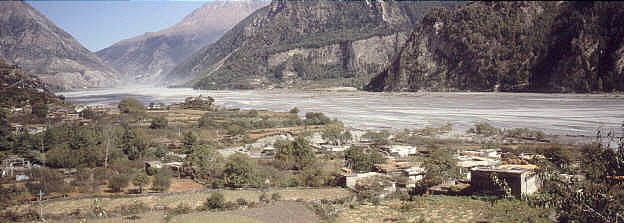
Three days later, I headed back down the mountain. By the seventh evening in October, I arrived in Larjung, a small village on the edge of the river where a few Tibetan refugees scratched out a living by growing buckwheat and marijuana. I rented a room for the night at a shabby guest house. Excepting years of dust and complex spiderwebs, my quarters were dark but comfortable. As I drifted off, I listened to the local monks playing football on the water's edge.
I dreamt of my mother that night. She was wearing an elaborate silver crown and a white dressing gown as she descended the far western escalator at Coronado Center, a shopping mall in Albuquerque, New Mexico. She was smiling and radiant and wanted to reassure me that things were just fine back at home.
Of course, that wasn't the case. She was actually in a hospital bed at Lovelace Medical Center, dying. It took me another week to trek down to where the road to Kathmandu slithered out of the mountainside. During that week, I saw some of the most sublime and wondrous and beautiful things a man might ever hope to see, but the bus ride back was long and shitty and hideously hairpin; I kept having to lean my head out the window to vomit.
I left Nepal behind a few days after my mother died in Albuquerque. I had ten American dollars and five-fifty in Singapore currency for the twenty-one hour plane ride back. At Changi Airport, I had a twelve-hour layover so I spent the sawbuck at the bar, drinking cheap whiskey. I passed out at my table and dreamed about my mother again. She was young and full of life and wanted to lecture me about what I needed to do to get my life together after she died.
The next morning I awoke to find the bartender rifling through my jacket, telling me I probably better get out of there soon and back to the transit lounge because someone might call the police; I had long hair, after all.
I spent the five-fifty on a burger and coke at McDonald's and almost missed my connection because I was watching the Crocodile Hunter, a new nature show that had just debuted on Australian teevee. It was being piped into the terminal in Singapore at various and sundry locations for the benefit and amusement of the multitudes of English-speaking passengers headed back home to warmth and convenience.
But, back in Burque, it was cold and windy. Winter was setting down its plan, much like it seemed to be doing last night. Mostly folks were glad to see me come back, but sad and angry that I had missed my mother's funeral. I drifted around very mournful for a couple of weeks, then took a job teaching English at Ernie Pyle Middle School. Anywho, I'd usually cry on the way to work from the Heights; Albuquerque was so beautiful, my mother was dead, and the Himalayas were very far away.
I remember a few people that I worked with down at that school, like the burnt-out science teacher who always wore chunky Navajo bolo ties and constantly picked at his goatee beard while complaining about how dangerous kids are these days. But mostly that part is foggy since I was still seeing mountains and temples and blood sacrifices to Shiva whenever I closed my eyes.
A little less than sixteen years later, I closed my eyes again as I sat in the back yard and soaked up sunlight while my dogs barked and danced around the vestiges of an Indian summer wherein the weather is damned warm during the day but cool and languid by night. Some sort of vintage aeroplane flew over the house at about four in the afternoon and its engines sounded mysterious to me.
Later on, at Ghetto Smith's, my wife and I passed Don Schrader in the produce department and he said howdy. He was wearing more clothes than I was used to seeing these past few months, it being autumn and all. I gave a respectful hello back and Samantha said hi and waved.
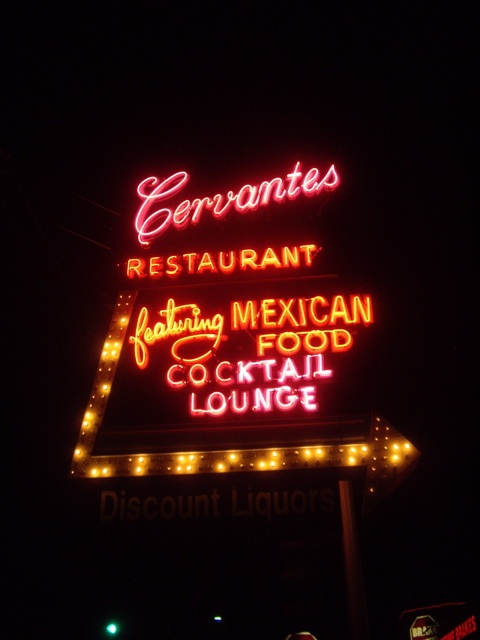
After all that, we waited at Cervante's Restaurant half an hour for our take-away enchiladas, but that was okay with me because you expect that kinda action during the first week of October when the Balloon Fiesta is upon us and the town, and that restaurant is also filled with tourists and pilgrims, ghosts and all sorta seekers of higher places. Just what you would expect in a place with mountains.






.jpg)