Welcome, nuevomexicanophiles!

Submit your email
Showing posts with label 1980s. Show all posts

01 December 2013

Five Albuquerque Instances

Rudolfo Carrillo

by Rudolfo Carrillo

I decided to assemble a collection of random memories about Albuquerque and put it down here, report fashion, for your reading pleasure. I have plenty of material. Maybe I'll do this a few times with some basic parameters, so it doesn't come off as tangential. Like tonight seems sort of long-legged and eighties style, except for one instance, if you happen to be concerned with topicality. I'll tell you though, sometime maybe I will unstring all this, make each paragraph into a different book like flowers coming out of the ground in springtime. But now it is just seeds and that is fine with me.


  • For a while I worked as a stagehand at Popejoy Hall, mostly before I was twenty. It was a helluva job and dangerous too. One of my duties was to climb up to the ceiling and drag around weights and pipes and scenery. The crew chief was huge guy who wore a denim vest over a variety of filthy heavy metal concert t-shirts. He chain-smoked Marlboro 100s and would yell, "You, up on the rail!" when he needed something from me. He hadn't combed his hair in ten years; his wife was named after a character on the Honeymooners. I think.
  • An automobile caught fire on the corner of Tulane and Coal one summer afternoon while I was trying to paint a picture of the apocalypse; staring at the Sandia Mountains for inspiration. A sky blue Dodge Colt rattled by and stalled at the curb. It was already smoking under the hood and the woman driving got out and started walking with a stiff gait, toward Nob Hill. Back then, a vicious Rhodesian ridgeback named Vincent lived on Tulane between Coal and Lead. As the driver of the burning compact rushed by, the dog leapt out into the street ready to bite.
  • During my freshman year at UNM the whole place was pretty much wide open. For instance, the basement of Castetter Hall was wrecked and abandoned but folks still went down there for the thrill, to make out, and to score broken lab equipment. The same with the labyrinth under the College of Fine Arts, dark and seemingly endless, with an occasional broken tuba or snare drum substituting for a distillation apparatus or busted autoclave.
  • I am sure as shit humans were living the Werner-Gilchrist whatever house as late as 1985, though media and historical reports seem reluctant to admit such. I lived three doors down the road that year. Whoever in hell was living in the dilapidated rancho  had a couple of late model chevys parked in the yard and a green house going that beat hell out of any other garden on that shabby road called after Cornell University. I'd hear the occupants playing the piano and carrying on late at night and wonder who they were. They did not come and go much.
  • I ambled in a very relaxed fashion around Johnson field twenty-three times while the three hippies I was with jogged and ran and threw themselves at the grass in great lithesome leaps, gamboling as they passed me again on that perimeter. It was just after dusk and the high intensity lighting array lent the action a dream-like quality that only dispersed after the outing, when the two women of the group began practicing astrology on guitars. I rose from the carpet and walked south toward the cemetery. 
18 July 2013

Stars Formed from Steel

Rudolfo Carrillo


by Rudolfo Carrillo

There is a collection of objects at the place where Girard, Monte Vista and Central intersect. Methinks it is called Triangle Park. It's not a park in the conventional sense, vasty green, filled with automatic sprinklers and all that.

At the edge of it, there's a neon-lit tower spanning Central Avenue. That comparatively rough concrete form is festooned with colors of all sorts. In its span across the wide street, this bridge of sorts announces the entrance to the
Nob Hill District.

There are some benches made up to look inviting. There's a police substation on the east side of the triangular area, and a few forlorn trees, too.

Nearby, the bus stops frequently.

For a long time, now a long time ago, there was a Chevron station and an eponymous bar at the confluence. I only went into the booze joint one time, but I used to use the air hose at the gasoline dispensary, all the time, to fill up the tires on my ride. In case you want to know, the car I drove was a nineteen-hundred-and-seventy-four Peugeot station wagon.

It was a classic alright, but I let some crazy music student paint the whole damn thing with paisleys, so it really looked like hell, like a bunch of hippies were responsible for the decline of European automotive power.

But that is a different story altogether. The stuff with the Peugeot was happening around the same time as some of the events in this narrative, so I thought I’d throw it in for sauce. I’ll tell about that art-damaged junker some other time.

Anyway, on the west side of the park, there is a bronze sculpture. Richard Beckman made the sculpure. It is called Star. I am not going to post a picture of Beckman’s construction because I want you to go take a look as soon as you can.

Beckman studied and taught at the
University of New Mexico Department of Art and Art History when I was an undergraduate.

In his plain-spoken manner, Beckman was the real deal, authentic in a complex world of artists, those who wanted to be artists, and the adroit charlatans who sometimes tagged along for fun.

While at UNM, Beckman made formidable metal structures that seemed almost to have been engineered, so precise were they in their handling of materials and construction: clean and angular, objects rendered with industrial formality.

The work on display at the entrance to Nob Hill comes from a period of immense production in Beckman's career, as he was concluding his studies at UNM.

At the small community of artists where Beckman worked and studied in the late 1980s, many of the other students, myself included, were totally freaked out by the quality of Beckman's work. Hell, the faculty felt rightly flummoxed by the dude. He was way more talented than the old masters that ran the show.

Beckman fascinated everyone. The undergraduates who listened to the
Descendents while pounding away on pipes and plates of steel in the metal shop wanted to buy him a beer at a watering hole called the Fat Chance Bar and Grill. Some gal from the ceramics division left a joint on his locker, sealed with a kiss made from a slip. The full professors waiting to hear from the biennial committee at the Whitney would walk around and around his output, adjusting their spectacles and clearing their throats.

I worked and studied with Beckman off and on, took his welding tips and wilting criticism because he was a nice guy and did not want to bullshit about this or that theory of postmodernism; he did not come off as pretentious or lofty and had the spirit of a working man.

One time, I volunteered to be part of a performance piece of Beckman's that was centered on a collection of steel objects he had crafted. He was quiet, polite and focused, very measured throughout. On the other hand, I danced around the sculptures in a bizarre new wave fashion heavily influenced by hours of watching the movie “The Truth About De-evolution”. The next day one of the professors stopped me in the hall. She told me she was fascinated by the authenticity of my performance.

Incidentally, those performances took place at an art gallery called Raw Space. Raw Space was Downtown, in the place Anatolia Doner Kebab now occupies. At the time, Raw Space was a popular place for UNM art folk. I had a show of my shitty paintings there once and a band called the Ant Farmers played at the reception. One of the songs they played was called Shower Curtain.

Meanwhile, Richard Beckman graduated and went on to have a substantial career in the art world. He taught at the University of South Florida, exhibited widely, had public commissions and essays written about his work, which had taken a departure, had begun to explore organic and quasi-biological forms with the same honesty of spirit as his earlier forms.

I only know this because I did some research on Beckman for a magazine article I was writing. I also found out Richard Beckman died eight-and-a-half years ago.

Most of that '80s crap I wrote about at the beginning of this essay—the gas station, the bar, the Peugeot and the wacky clarinetist with spray paint and paisley stencils—have all but vanished. The sculpture lab is pretty much the same though, down to the perplexingly aloof faculty and buzz-saw swinging students, I reckon.

But Beckman’s work is scattered grandly, memorably across America; some of it is here in this town. Go down to the place I told about and take a look. In the rain, or anytime, forever, Beckman’s Star is wondrous.

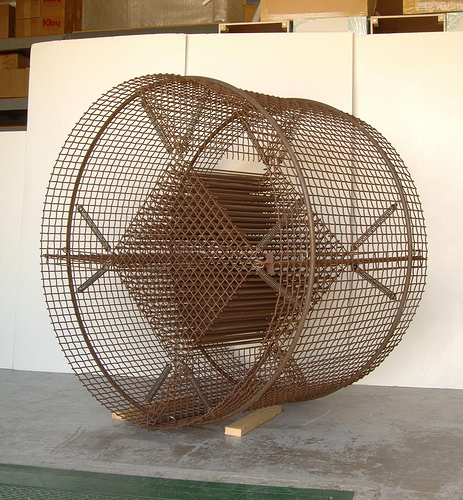
Editor's Note: The sculpture pictured above is by Richard Beckman and was featured in the performance piece written about above. The photo was taken by Richard Beckman at UNM.

04 May 2012

ABQ MTV: From the '80s

Unknown

Things in Light is pleased to present the sixth installment of ABQ MTV.

► First up, check out the funky sorta art rock-slash-new wave sound of Taos-based band The Refrigerators, performing "Dawn Patrol" in 1981.


► Second, indulge in the prog-funk stylings of The Wet Sox, performing "DDD & E" in 1981, as well.


► Third, here's a short film by Alan Swain called Kitchen Parties. It introduces the viewer to authentic Burque '80s house party culture via documentary footage and Albuquerque streetscapes — including one scene that features the notoriously greasy Vip's Big Boy. Soundtrack by Jerry's Kidz.


►The final entry in this installment isn't technically a music video, but es lo más chingón, so we had to we had include it — Treadmill's cover of Peter Gabriel's "Shock the Monkey."

26 April 2011

ABQ MTV: Flashback Film

Unknown
Image courtesy of cracksinthesidewalk.com/

Things in Light is psyched to present another "episode" of ABQ MTV, featuring local music videos that hark back to '86.

Our first video was broadcast live on Channel 27 in 1986. It features a musical intro by fringe-y Albuquerque new wave keyboard artist Rodger C. Venue. Then, seminal Albuquerque punk rockers Cracks in the Sidewalk share the "Leatherword." Check out youngsters Gordy Anderson (Black Maria, ex-Jerry's Kidz) Chris Partain (ex-Starsky, ex-Elephant, Star Tattoo), Judson Frondorf (designer, "PowerBook-fronter"), and Jez Velasquez (collage artist).

---

Was that minute-long Rodger C. Venue intro just enough to whet your appetite for synth? You're in luck, 'cause here's a Venue vid from '86, "Danger City." And there's more synth-y goodness on the Rodger C. Venue Myspace, which indicates Venue is now calling Austin home.

---

I would surely be remiss if I failed to include this Cracks in the Sidewalk "Down" video from '88.

---

And, for good measure, here's Cracks in the Sidewalk performing in '94 on 5000 Feet High (Ch. 27).


Coprights @ 2016, Blogger Templates Designed By Templateism | Templatelib - Distributed By Protemplateslab