Welcome, nuevomexicanophiles!

Submit your email

22 September 2013

Three Eternal Devices for Navigating the Fall

Rudolfo Carrillo

by Rudolfo Carrillo

The clock on my computer says summer is over.

We have a few of these sorts of graceful machines—note to local burglars: I also have a ninety-pound red hound dog with a blue tongue and white teeth who is trained to devour strangers—but most of the time I do my work on a G4 that runs Tiger, Motorola processor y todo.

It can be slow and is ornery as hell, but it is just fine with me and I would keep it forever if I could. I've been through a few keyboards. (Flat white is a damn poor color if you like to eat pizza whilst typing.) But I think there have only been two times when the thing did not boot. 

Using the G4 is part of a personal ritual. My rite late last night, taken up with due gravity as the Pleiades swung into view, was about how everything before now continuously leaks away into the air, leaving consequences turned out into the world. The retrieval of the past's output as image and narrative is one result of this process.

I've been marking time this way for years and years, though meaning creeps toward abstraction and into sudden sea change as the middle of my century rises. The procedure also has the potential to mutate into cleverly shitty, multi-paragraph introductions designed to defend the use of a type of symbolism based in the neuro-mechanical reflections and quantum entanglements that comprise the past.

If your universe does not work in the manner I just told about, that is just fine with me; every head is a world. But I probably could not make anything at all from the temporal residue data collection area I've built from starlight and bad decisions, if not for dreamy mechanism.

I have bound myself variously to elaborate and arcane techniques perfected in the foothills of the Himalayas or else incorporating passages from all American television broadcasts into my skeletal structure with the specific purpose of gathering evidence of the discomfiting presence of magical postmodernism among a representative collection of widely divergent human organisms.

I hope you think that's funny. It is important to me that you have a good laugh while reading this, because I sometimes see my memory as a curse, and you ought to, as well, I reckon—when every moment is just hanging there like a big iron rock in the asteroid belt waiting to be mined by the well-intentioned but nonetheless colonial forces of some eccentric Earthling's half-ass literary career.

Eleven years ago, when a very different summer was declining, I met a dog that had been run over by a fellow I happened to know from art school. I saw that dude the other day in Nob Hill. He was driving a bright green convertible and hell, he is my age. I was going to walk over and bust his balls about the car or how he split after the accident, leaving me with a bloody and frightened dog, but "Karma Police" came on the radio and I kept driving. I figured he had probably forgotten all about me and was probably late to this or that country club anywho.

Back then, the dog lived, and she turned out to be a good friend of mine. I wrote all kinds of stuff about that day, about the years that followed. Now, this has been the second summer she is gone from here. I did not notice the summer before this one. I stayed in and wrote and dreamt. That summer of two-thousand-and-twelve I dreamed I left the back gate open—that her owner had finally seen a found dog sign I left at the community center ten years before, and had come to take the dog home.

She had the worst kind of cancer. The doctor ended up amputating her left leg. Her right leg had been busted on the faraway day in September I told about. I was always worried about her legs; she could not stand the rain. The night she died, I was sitting next to her, trying to convince her to contemplate the goodness of water.

She was unconvinced, was weary of earthly stuff. The dog looked up at me, nudged me with her nose and as death washed over her, an elaborate, elusive, smoky and oscillating structure appeared between us briefly and fluttered. I reached out with one hand, and the form vanished. She left behind an empty vehicle. It had the shape of dog, but it was not a dog.

After that, and at night, asleep in order to reckon with the permanence of that passage away from the land and the food and the flowers, I began to employ an all-access, backstage pass to Tlalocan, given to Cabeza de Baca after years of servitude and lonely wandering. I inadvertently scavenged this talisman from a landfill in Hermosillo in 2001, while searching for a G4 possessing magical properties and applications from beyond the stars.

The temporal displacement unit usually lands me in a vast laboratory with astronomical qualities or a byzantine transport center filled with thin locomotives and speedy aeroplanes. Sometimes, I see Rosie and the dog hops up into my lap or leads me to a telescope where I can see planets on the very edge of the galaxy, against the darkness of the void. In the morning though, the sun is bright. I am surrounded by life; yet she is nowhere to be found on this earth.

The ritual begins again as I wander out into the living room, shoeless, and greet my wife. The rest of the pack circles around her and then follows me out the back door, into autumn.

15 September 2013

State Fair, Part 49

Rudolfo Carrillo

by Rudolfo Carrillo

Imagine for a second it is the future and you leave the Earth behind. Your spaceship is well-equipped though, and it is easy enough to make contact with your handlers back at the watermelon ranch.

Maybe one day, when you've started to lose track of the distance between Lomas Boulevard and Jupiter's inner moons, when the days melt into one long dream of calabacitas, you decide to give headquarters a bell. You ask them if it has been raining lately. When the words, "yes, a lot" crackle and hiss through your specially designed bio-engineered headset, you reply, your sense of time and space kindly reconnected. And you say to the folks in Burque, who are just about a billion miles away by now, "Have you all been to the State Fair yet?"

That is a supposed vision of the future, just to sorta float around the idea of ubiquity, sabes? Besides being the preeminent event in this town three-hundred years from now, it is a well-known fact that the fair is a culturally weighty aspect of our beloved military outpost in the desert. Among citizens, visitors and wanderers, it remains a source of many highlarious and culturally relevant anecdotes.

With that in mind, here are some vignettes, highlighting over forty years of engagement with the gaudy and sublime moving object that rises up yearly from semi-trailers, champion vegetables and twangy guitars echoing in the rodeo hall.


i.

The old man would set aside three days to see the fair. It was good as hell to get away from Gallup. We would stop at the Dairy Queen in Grants for lunch. In nineteen-seventy-five we crested Nine Mile Hill while Kung Fu Fighting played on the radio.

We had a room at the Hilton and drove over to the Fairgrounds in the morning. The other Rudolfo liked to park the car under a big mulberry tree behind the Wine Cellar, which was a bar in Fair Plaza. He said it was a special parking place that belonged to his mysterious business partner. He called this man Sabu. That wasn't his real name and he wasn't from around these parts.

I ended up eating way too much fry bread to compensate for the anxiety such knowledge brought. I refused to get on the tilt-a-whirl with my brother and sister because I felt weird. But I was okay with all of that. Later on, I met a gal named Lisa at the hotel swimming pool. We shared a cigarette and she told me all about California. Her mother had an Arabian horse.

ii.

Some friends of mine at art school thought it would be really ginchy to enter some of their work in the fine arts competition at the nineteen-eighty-six New Mexico State Fair. They wanted to show off the idea that not all artists in New Mexico were painting pictures of this or that church or elsewise carving eagles and cutthroat trout out of tree trunks.

One fellow, a formidable sculptor by the name of Stanley Olivarez, submitted an intricate, highly crafted kinetic sculpture. The only reason I can't describe his work in more detail is because of Rob Hawkins. Hawkins' submission caused me to forget about any other work of art on display at the fair that year.

Hawkins had been trying to get into grad school and was known for coming up with ideas that were guaranteed to infuriate his professors. So, Rob asked if I would drive over to the fair with him to deliver his piece. We parked under Sabu's tree and Hawkins opened the trunk.

He grabbed a dirty old basketball, the right half of a rotten pair of Converse All-Stars and said, let's go dude. Inside the exhibit hall, Hawkins set the ball on the shoe, filled out the paperwork and winked at the judges on the way out. He won a second place ribbon for that concoction. Olivarez got top honors and sold his work for some decent feria, but I still can't remember what his sculpture looked like.

iii.

They used to have a paint-ball booth on the midway. Some dude dressed up in a gorilla suit would come out of nowhere and folks would shoot at him. I went to the paint-ball booth with Rob Hawkins after he picked up his award, after a camera-jockey from the local newspaper took his picture.

Hawkins looked me over like he was trying to decide whether he could trust me or not. He bought thirty rounds of paint-balls with his award money. Then he let loose on the gorilla suit. He said between clicks that he had been rejected by the MFA program at UNM. After about a minute of that, the dude in the gorilla suit ripped his mask off and told Rob Hawkins he would come over and kick Rob's ass if he kept aiming for the head. Hawkins gave the finger and zapped the dude right between the eyes.

The chase that ensued followed along, past the Asbury Cafe and through Villa Hispana across San Pedro and over to Sabu's secret parking spot and magical mulberry tree. "Kung Fu Fighting" was playing in the background. Rob Hawkins climbed up into the tree and disappeared in flash of postmodern mumbo-jumbo.

His former target wandered back to the midway office, took what pay was coming to him and spent the rest of the day wandering though the fair eating roasted turkey legs and tiny donuts.


07 September 2013

Two Interludes from the Heart of Fringecrest

Rudolfo Carrillo

by Rudolfo Carrillo

The staff of Things in Light, dogs, ghosts and ghosts of dogs included, are listening to the Jefferson Airplane tonight. One of the Carrillos is piping Crown of Creation through a computerized audio output device. We are just getting buried in the first side, in case you want to know, and that activity is a perfect opportunity to test out the new shiny white keyboard on the G4 in the corner. As is our custom, two random observations or incantations follow.

***

I.

The episode of Star Trek available for consumption tonight by Albuquerque residents in possession of a specific brand of satellite reception equipment is an episode called "Errand of Mercy". It's about how the Enterprise was dispatched to a faraway world to prevent further atrocities from being committed by a ruthless, militaristic empire composed of dark men with pointy eyebrows, metallic sashes and murderous methods.

Anyone who's been to an American studies conference knows that teevee shows like that were meant to serve as commentary on the conflict the USA had with a horrible bear-shaped thing called the USSR, back before anyone at all had a computer at home. This was when telephones were big, heavy affairs with cables and dials and a thing called a trunk connected the continents together.

On that faraway segment of the space-time continuum, our nation was at war, not so much with the bear but with the ideas the bear had spread to its neighbors. Instead of having to confront the bear itself, it was widely thought to be adequate to fight his far-flung followers, to make blood sacrifices of them in a country and among a culture that neither the bear nor his American adversary really understood.

Eventually the bear died from an ironic combination of neglect and greed. Meanwhile on this week's iteration of Star Trek, Kirk goes on and on about justice and the price of war and whatnot. As usual, Spock does most of the heavy lifting. Somehow, better angels prevail and war is averted. At story's end though, one of the swarthy enemies of civilization remarks that a war between two superpowers, on a planet and among a culture neither understands, would have been glorious. Pretty locochon, eh?


II.

When I was growing up in Gallup, New Mexico, there were three movie theaters. One of them was a drive-in called the Zuni. The other two were sit-down joints in the middle of town. The two film houses, El Morro and The Chief, were only a half a block apart in the generally enforced reality that bound them to the earth, but they might as well have been separated by a distance comparable to what one would experience flying to the moon on an Orion III space plane. 

I saw 2001: A Space Odyssey at the Zuni. It was the late show and the rest of my family, except my infant sister, was asleep in the old man's Pontiac Executive. I gave her some Similac and she laughed mysteriously near the end of the film, during the Starchild part.

El Morro was dark and wooden with red velvet curtains and a clock that glowed in the dark. One Saturday I watched Soylent Green down in the front row.  I spent the next month terrified whenever I accompanied my mother on her errands. I was convinced that large government bulldozers would appear at any moment to scoop up the hapless patrons of the California supermarket.

That all sounds really bitchin' and nostalgic, but the shitty thing was the Native population of Gallup didn't really get to go to either the Zuni or El Morro. They all went to the Chief. The classism and racism that supported this example of segregation was quiet and efficient, de rigeur. The town soaked in the oil of despair. The Chief was Gallup's symbol of the dire consequences of colonialism.

The Chief was a stormy place. There were no rules under that roof, but ashen clouds over it. The fare was grindhouse (kung fu and violent horror, mostly) and in-between shows hard rock crackled through the sound system. I am pretty sure the Chief closed down the same summer we left for Albuquerque. I don't know what happened after that, but I reckon things got better when some corporation or another built a multi-screen megaplex on the north side of town.

***

Now we are just about finished listening to Crown of Creation. Everyone here at Things in Light agrees side one is where it's at. Especially the opening track, you know, "Lather." It's also been clearly reckoned that, when read aloud, both of the brief narratives included here have a sense of completion about them. Plus which, it rained this afternoon, and we want to walk around in the dark in Fringecrest, listening to the plants and trees rejoicing.


18 August 2013

Summer's Lease: Mysterious Quantum Forces Unraveled

Rudolfo Carrillo

by Rudolfo Carrillo

I dreamt I went to a party in the Northeast Heights. Esta accion was up on Montgomery, near Morris. For those of you with an interest in psychogeography, that vecindad is where my brother and I delivered the Albuquerque Tribune in the late nineteen-seventies.

Some of the houses around there were awfully deluxe, and now and then we'd run into a pool party complete with roast beef sangwiches and mimosas. We soon found those were the types of habitations with owners likely to tip around the holidays, especially if the paper was laid out by the front door, neat and regular.

Otros chantes thereabouts were shambling testaments to the fragility of the middle class with cars parked on the lawn and porches that smelled of dog shit and Coors Banquet Beer. You'd more likely get bit than collect, so we usually let those customers be until the Albuquerque Publishing Company cancelled them for non-payment.

Anywho, my dream wasn't anything like that because the fiesta que estoy describiendo took place in a high-rise apartment, but you could still see the Sandia Mountains from the balcony, sabes? I did not know a soul there. I mostly spent my time in one of the bedrooms staring at a wooden cabinet that somehow seemed familiar. In the hallway, folks were admiring the carpet and talking about a bat flying around the light fixture.

When I looked away again, the place was empty. Even the murciélago was gone.  I checked the refrigerator for pizza and sat down in front of an oversized plastic television set with a cold slice of Godfather's. Star Trek was on. It was the episode where two planets are waging war by computer and the losers have to self-disintegrate. Kirk and Spock destroy the computers in the end; fear of real war brings peace. Bárbaros, that's some cold war shit, I said to the dreamworld as I got up to leave.

Outside it was an emergency because the entire building was on fire. Everyone from the party was standing on the corner watching the flames wag their tongues like hungry leaves all around the doors and windows. Since there were a number of cool ranflas parked nearby, I picked a nineteen-seventy-one Saab 96 with pneumatic controls and switches designed specifically for underwater use, and I got the hell outta there.

The sun was just flickering back on as I made the corner of Morris and Lomas Boulevard, turning west toward our headquarters, where I let the old car float away and promptly crawled back into my sleeping skin. I was waiting for the alarm to sound.

10 August 2013

Sonnet Composed Under Saturn

Rudolfo Carrillo

With summer's peak brooding on this portion of the earth
and thunder everywhere, I walked you to the restaurant with
legs carved from saturnine consequence. You know the place
I mean, it beckons the hungry with visions of the last frontier and
a tortilla machine that came from the future. Carlos the ragman
was in the corner by the toilet folding cigarette papers
into swans, lifting his eyes to heaven. The light from the sun
was changing into a crafty autumnal version of itself. You wanted
me to know all about that process as a function of interactions 
between rain-soaked hands and the moons of distant moments.

I watched shadows jangle around while a voice in the air
called out a series of numbers symbolizing discrete nutritional units
ready for consumption by the humans surrounding our conditionally
ringed universe in back of the joint, under the painting of John Wayne.

- Rudolfo Carrillo

27 July 2013

3. Guadalupe Santos Trujillo and the Night Sky

Rudolfo Carrillo


by Albino Carrillo

Guadalupe Santos Trujillo had been riding a silver-green15-Speed Ross Mountain Bike since he saw it for sale during a dope run over to the college campus.  After he dropped off some G-13 for a couple dumb hippies from Vermont who were waiting for him in the all night Laundromat (these were in his “bicycle days”) he found himself in the tree-lined part of town banging on the heavy oak door of an old Professor who was waiting for a Ms. Julia Walpole to take a look at the thing:  a sky blue 1967 Volkswagon Squareback.  He had seen it in the distance and likened it to candy.  Sweet metal candy.  The coolest thing was that it was in almost cherry condition.    After selling a pillow, Guadalupe had the cash then and there, and even though this greatly confused the old man at first, twenty minutes later they were at the kitchen table, filling out the title transfer.  
Guadalupe had plans.  Snatching up the title so quickly that the professor’s yellow Lab barked from where it was on floor beside the stove,  he strode out, just as Julia Walpole knocked on the door.  He slipped past her and past the professor, who still held tightly in his weak hand the wad of fifteen 100 dollar bills that he’d just made.  The only thing Guadalupe left behind was a certain acidic smokiness that wouldn’t linger in the air much longer that Walpole’s patchouli.  Her eyes were wide with astonishment.
Now the car had never acted up before, and with the car Guadalupe thought he could extend his business and his social life.  He had been riding up to Santa Fe on the Sun-Runner every weekend to sell weed to the hippie crowd frequenting the Japanese-Style hot-spring baths, the same who went dancing to World-Beat music all night at El Club Suroeste.   Guadalupe Santos Trujillo’s main problem was that he was always running away:  this started when he was a boy.  He’d sit at his desk all day at school making up other realities—he thought for a while he was the son of a king, lost and adopted, certainly not the son of his real father, an old alcoholic encyclopedia salesman who’d disappear into the deep expanses of Central Texas for days in search of profit.  Because he could too clearly imagine his father hobbling up to a small one-story stucco house framed by 3-foot high galvanized fencing in search of a sale, he could also imagine that he’d be rescued someday, recognized and taken to a castle or palace that would be all his, somewhere in La Extremadura de España.  Of these places he’d read, and had spent hours copying heraldic shields from the set of Britannicas his real dad had won in a sales contest.
So when he found The Audubon Society Field Guide to the Night Sky under the passenger seat one evening while he was trying stash a pillow of Diesel under it, the first thing he thought was how far he could already see:  back then, the night sky in New Mexico was still clear and black and icy.  He drove to Santa Fe on the back road, through Madrid.  The crowd at El Club Suroeste was typical for a Saturday night in mid-June:  güeras from the U, local gals from Taos dressed up like their mothers, like fresh young hippie things:  toe rings, hip-huggers and flip-flops.  The boys and men mostly a mix: the Santa Fe locals who, as lawyers in the daytime, wore pressed chinos and starched shirts; the locals with black, straight hair, leather jackets and big belt buckles; the star-struck boys who liked the wild hippie southwestern look—turquoise rings, maybe even a heishi, faded 501’s, Birkenstocks, the distant pot-soaked bedroom eyes of John Lennon.
It occurred to Guadalupe, at that moment of intimate self-reflection when he dug his hand around and underneath the passenger’s side seat in the blue VW and could hear the noise of the band playing on the patio, that he had come upon very lucky moment:  kneeling, with the door open, Guadalupe, while fishing for the big bag, grabbed the book instead—with it, the first thing he did was turn to the point in the book that is full with color pictures of stars, nebulae, and galaxies, in particular a crystal clear shot of M 51, the Whirlpool Galaxy.
The streets in Santa Fe are small, narrow paths that remind you that the Spaniards built this city in the 1600’s.  They reminded Guadalupe of the time he’s gone to Spain for the summer, actually traveling to the small city Alburquerque. It was the cobblestone, the neat two- and three-story stucco buildings that did it for him.  In the bar, he immediately and without plan ran into Julia Walpole who of course, when the blue VW pulled-up on the curb, next to the bar, was sucking on her second clove smoke, her schooner sized margarita almost drained.  Walpole had become what a TV producer or urban sociologist might call a semi-regular—she knew two of the waitrons by name and the host often talked to her about his trouble getting good bus help.  This because Walpole had once accused an ugly, slightly chubby Peruvian bus-boy of stealing her watch from the bar where she’d left it while talking to a friend she’d met in the hallway by the restroom. It was behind the door labeled Mujeres all the time.   The watch, a sliver-banded Bulova, actually had been her father’s; she simply picked it from the bedpost the night after her father died in his sleep—all it needed was a new mainspring.
It was the way he was sitting in the car that drew her attention.  Guadalupe had bought the car before anyone even had a chance to drive it around the block or make an offer.  It had been sitting for a while.  The truth was that they had known each other in college, 20 years ago now, the desert still the same night after night the same stars, the same lonely people, now in their 40’s driving drunk between ‘Burque and Santa Fe, still looking for kicks and UFO’s out there on the Turquoise Trail, stoned on ecstasy or G-13.  Being lost in the Southwest was a gift and a sentence.  The blinding blue sky literally drains your will to move on, drains you of ambition and color.   And even though you may be skin-darkened by the insufferable sun, that is in itself is a reminder from the desert, of human frailty.
At the wrought-iron entrance to el patio del Club Suroeste, then, Walpole walked right up to poor stoned Guadalupe and with one hand grabbed the book of stars and kept smoking with the other: 
“Hey, motherfucker, that should’ve been my car.”
She pushed him hard, like Elaine Benes would, as she grabbed it, twisting with all her weight like she’d learned in a self-defense class.  Too stunned to react (he had smiled broadly at her as he entered the courtyard) he stumbled away.
            “Hey man, what the fuck…nice to see you, too!  He pushed back against the wall and she slipped in a puddle of beer.  He kept his hands up like he’d learned in jail.  “No way.  I fell in love with it the minute I saw it, and I had the money and I, you know, it was the right time.  Like it was all set up, cosmically.  I wanted something like that car since High-School.  Have you seen the dashboard?  Not a bit of sun rot.  And, anyway…why do you want an old hippie car?  Some goddamn book came with it too.”  Guadalupe knew he was lost.  The book might explain, what?  He was way past that here, and the alarm was ringing in his head.  They opened it together.
On his right, the open portico to the street yawned and was tired.  Walpole hung back on the patio wall and Guadalupe was vaguely sick.   “Have you ever seen the stars from behind the Sandias?” he asked, as he hot-boxed Marlboro Menthols and nursed a beer he didn’t want.
“No.  Well, driving, yes, she said.  You know I’m from Missouri.  We have stars out there too.”
“Naw, what I’m talkin’ about is the thick white Milky Way you can see if you drive to Madrid and then over the mountains.  There’re some clear meadows out there and you can see forever!”   He said this as his heart pounded and he wondered if he were really alive.  Julia drank another Lone Star as she flipped through the Field Guide, dog-earring some pages as she went.   
            The drive down to ‘Burque is always furious.  Even more furious that Walpole was following him down I-25 at 75 miles an hour in her 1985 Ford Ranchero GT.  After sitting in the bar for almost an hour, they’d decided to go out to the llano to see the stars in the naked black sky that was there, hanging over the desert.
            It’s almost all downhill to ‘Burque.  Guadalupe could see Julia closing at times as he neared the Sandia Reservation cutoff that would take him into the dark hills.  They drove like racers, taunting each other, flying by at 85, shouting, flipping the bird at one another, laughing, thowing empty bottles of beer out their windows.    But it was on a straight two-laner just north of Burque that his mind began to drift into the dark night swallowing the foothills into fog.  He had formed a map in his head:  soon, he and Julia would be sitting on the hood somewhere, staring at the nothingness that is space, naming stars from a book, looking for a page not in that book.
            A bottle tumbled carelessly under his feet as he made the wide, dancing curve that took him onto Sandia Pueblo land.  He could see the lights of ‘Burque far to the south and they looked like lost stars from a map he imagined.  He gunned the engine, with Julia riding him parallel along the two-lane highway that lead to the other side of the Sandias.  They threw kisses and cursed one another.  Going east briefly, his eyes caught the dull, surprised eyes of a coyote crossing the road.  As they both roared past, it vaguely turned to watch a rabbit farther down the road.  In a few minutes, the rabbit would be dead in the coyote’s jaws.   Far in front of him, in the darkest corner of the northeast sky he could see the Pleiades rising, its cup of hot blue stars casting a 440 year old light on the scene.   

25 July 2013

Doña Trujillo: There’s a place in the desert outside of Hatch

Rudolfo Carrillo


by Albino Carrillo

            There’s a place in the desert outside of Hatch, New Mexico that you knew about.  Wild mallow, sagebrush, lots of cottonwood and pecan growing along the irrigation ditches.  We’d been there when we were both younger.  I probably didn’t even talk to you then.  Seriously.  Your mom had become estranged from the rest of us.  I don’t know why.  Then one day we told her that Ruby Martinez had died in fire—a terrible way to go, out in her mobile home while Mosca was away getting some feed for the goats.  Some said he done it:  after all, 12 years before he had set up an ingenious method of killing her with a booby-trapped door, some wire and a shotgun.  He was stupid enough to try it out and ended up losing a lot of his gut.  Blood everywhere.  She thought he was trying to kill himself.  Can you believe it?   They sent him up to Santa Fe.  Five years for nothing.  When he tried to pretend he was insane, they got a hold of some letters he’d written to his brother. 
             I wanted to take you out here to see the land your grandfather used to farm.  He couldn’t get it right:  every year the field would flood, and we’d be left with rotten melons or drowned alfalfa.  When the well he dug went dry, he started fixing people’s toilets and sinks, sometimes he’d dig a well for someone.  That’s why there’s all the plumbing in the barn now.  He was the only one the neighbor could count on.  There were always the pecan trees and the pigs and goats to get by.  By the time John was born, we’d lived in two different double-wides:  dad finally found a spot that didn’t flood.  We even had a patch of lawn on the shady side under some old hickory trees.  The bugs were always a problem:  their numbers would swell in August with the heat and the vapor rising from the fields cut into the dry, yellow New Mexican desert. 
            I didn’t know if you’d make it out here.  Your mom told me that you and your new girlfriend were driving from Phoenix to get away from the heat.  I know there’s a road that cuts out from Deming through the wild llano:  there was a town halfway between here and Deming … just a bar actually, and a couple gas pumps.  Since the Union Pacific line ran right along that highway, you could stop to see the long trainloads of cotton, pecans, and cattle streaming toward from the border, their hungry crews sometimes stopping the 120-car train with five engines humming like giant bugs right by the road so they could eat a burrito and have a Budweiser before continuing to Radium Springs then north to Albuquerque.  You and me are like brothers and sisters separated in that old way:  you know, your dad was one of 7 kids in his family growing up on that melon farm in Las Cruces.  I’m so glad you made it out here.  We can smoke a joint in the arroyo here, under the bridge.  When you and John were kids, you’d go out there to shoot bottles and bats and even crows who hung out in the telephone wires overhead. 
            Well, my mom asked me to tell you that they think John was high and drunk when he got into it with the cops.  It went like this:  you know, he’d been driving between here and Silver for that job.  Working for the mine is a big deal, you know?  It beats fuckin’ doing nothing here in Hatch—yeah, um there’s the Orquiz warehouse and the highway department picking up dead dogs and towing cars from the interstate—working at the mine at least provided pay, and a change of scenery.
            You’ve gotta know, right away, that the accident itself was crushing … He didn’t have a chance.  Your dad got us the names of some good attorneys in Silver and in Cruces.
            John had been stopped before, for DUI, holding, and even got roughed up in the juzgao a couple times.   It’s just so hard to think he’s gone.  When he’d drive down to Tucson to see me, he seemed like he’d grown up and he was ready to live.  “Hey, I know you,” he’d say, like I was his sister, and not his mom.  There was something in the way he said it that I knew he was angry and incomplete, mostly because of me.  What kind of life did he have in Hatch?  What I remember most is that long drive through nothing between cities:  erosion, sandstorms, maybe one thunderstorm in the summer boiling over Elephant Butte, drenching the valley in one violent amethyst passage from heaven. 
            The last time you came out here your mother was still alive and actually talked to us.   I’d been living in South Dakota with John’s dad.  Remember, ese?  We came down to see you guys when you were only ten or eleven.  Your dad was working in Gallup and your mom wouldn’t talk to me because I had given John up to my mom the way my mom had given up your mom to Nicanora.   But there wasn’t any indifference on my part—see, I loved John and wanted him to be safe in Hatch.  That’s why I brought you out here.  His grave sits alone in the yellow dust day after day. You can see the Deming Mountains from there, and when the sky is really clear, you can see the whole Mesilla Valley folding out along the Rio Grande.
             What I wanted to tell you was about the darkness I found in my heart after John died.  His life never allowed me to see it.  That was the joy of life.  But since I didn’t have much to do with him as a kid, that darkness grew and grew in me.  And in him.  I knew this when he started drinking and drugging.   I knew this when he’d fight with dad and when he’d come back with loaded guns—you know I love my dad and can’t accept what your mom says.  But John hated him.  Even when they were out in the field at the end of the day shutting off the irrigation pumps, even when they were sitting in the kitchen eating the fresh tortillas and beans my mom had cooked.   They say John hated the world and that he was a petty criminal, a drunk, a pothead kid from the fields who was just following through on the path hewn by some guys just like him … His friend Rich had been in and out of jail just like him, and they’d known each other since fifth grade.  So it all added up to shit, mijo:  the fast pick-up trucks, the beer, the long highway drives for no good reason other than to get wasted and go fast on some farm road.  Maybe it was the speed, the acceleration, that freed him up from who he was and who he couldn’t be.  I can see him now flooring the old Ford 150 on the interstate, unaware of the darkness around him, slowly becoming tuned to the darkness inside that beat the hell out of him when he slept, when he dreamt.

18 July 2013

Stars Formed from Steel

Rudolfo Carrillo


by Rudolfo Carrillo

There is a collection of objects at the place where Girard, Monte Vista and Central intersect. Methinks it is called Triangle Park. It's not a park in the conventional sense, vasty green, filled with automatic sprinklers and all that.

At the edge of it, there's a neon-lit tower spanning Central Avenue. That comparatively rough concrete form is festooned with colors of all sorts. In its span across the wide street, this bridge of sorts announces the entrance to the
Nob Hill District.

There are some benches made up to look inviting. There's a police substation on the east side of the triangular area, and a few forlorn trees, too.

Nearby, the bus stops frequently.

For a long time, now a long time ago, there was a Chevron station and an eponymous bar at the confluence. I only went into the booze joint one time, but I used to use the air hose at the gasoline dispensary, all the time, to fill up the tires on my ride. In case you want to know, the car I drove was a nineteen-hundred-and-seventy-four Peugeot station wagon.

It was a classic alright, but I let some crazy music student paint the whole damn thing with paisleys, so it really looked like hell, like a bunch of hippies were responsible for the decline of European automotive power.

But that is a different story altogether. The stuff with the Peugeot was happening around the same time as some of the events in this narrative, so I thought I’d throw it in for sauce. I’ll tell about that art-damaged junker some other time.

Anyway, on the west side of the park, there is a bronze sculpture. Richard Beckman made the sculpure. It is called Star. I am not going to post a picture of Beckman’s construction because I want you to go take a look as soon as you can.

Beckman studied and taught at the
University of New Mexico Department of Art and Art History when I was an undergraduate.

In his plain-spoken manner, Beckman was the real deal, authentic in a complex world of artists, those who wanted to be artists, and the adroit charlatans who sometimes tagged along for fun.

While at UNM, Beckman made formidable metal structures that seemed almost to have been engineered, so precise were they in their handling of materials and construction: clean and angular, objects rendered with industrial formality.

The work on display at the entrance to Nob Hill comes from a period of immense production in Beckman's career, as he was concluding his studies at UNM.

At the small community of artists where Beckman worked and studied in the late 1980s, many of the other students, myself included, were totally freaked out by the quality of Beckman's work. Hell, the faculty felt rightly flummoxed by the dude. He was way more talented than the old masters that ran the show.

Beckman fascinated everyone. The undergraduates who listened to the
Descendents while pounding away on pipes and plates of steel in the metal shop wanted to buy him a beer at a watering hole called the Fat Chance Bar and Grill. Some gal from the ceramics division left a joint on his locker, sealed with a kiss made from a slip. The full professors waiting to hear from the biennial committee at the Whitney would walk around and around his output, adjusting their spectacles and clearing their throats.

I worked and studied with Beckman off and on, took his welding tips and wilting criticism because he was a nice guy and did not want to bullshit about this or that theory of postmodernism; he did not come off as pretentious or lofty and had the spirit of a working man.

One time, I volunteered to be part of a performance piece of Beckman's that was centered on a collection of steel objects he had crafted. He was quiet, polite and focused, very measured throughout. On the other hand, I danced around the sculptures in a bizarre new wave fashion heavily influenced by hours of watching the movie “The Truth About De-evolution”. The next day one of the professors stopped me in the hall. She told me she was fascinated by the authenticity of my performance.

Incidentally, those performances took place at an art gallery called Raw Space. Raw Space was Downtown, in the place Anatolia Doner Kebab now occupies. At the time, Raw Space was a popular place for UNM art folk. I had a show of my shitty paintings there once and a band called the Ant Farmers played at the reception. One of the songs they played was called Shower Curtain.

Meanwhile, Richard Beckman graduated and went on to have a substantial career in the art world. He taught at the University of South Florida, exhibited widely, had public commissions and essays written about his work, which had taken a departure, had begun to explore organic and quasi-biological forms with the same honesty of spirit as his earlier forms.

I only know this because I did some research on Beckman for a magazine article I was writing. I also found out Richard Beckman died eight-and-a-half years ago.

Most of that '80s crap I wrote about at the beginning of this essay—the gas station, the bar, the Peugeot and the wacky clarinetist with spray paint and paisley stencils—have all but vanished. The sculpture lab is pretty much the same though, down to the perplexingly aloof faculty and buzz-saw swinging students, I reckon.

But Beckman’s work is scattered grandly, memorably across America; some of it is here in this town. Go down to the place I told about and take a look. In the rain, or anytime, forever, Beckman’s Star is wondrous.

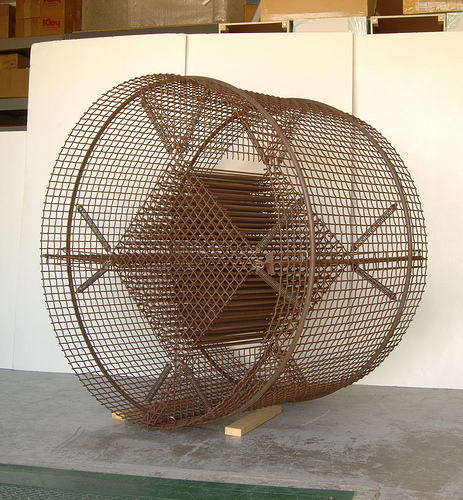
Editor's Note: The sculpture pictured above is by Richard Beckman and was featured in the performance piece written about above. The photo was taken by Richard Beckman at UNM.

09 July 2013

The Moth From Room 123

Rudolfo Carrillo


Rudolfo Carrillo—eminent master of nothingness, pollinator of datura blossoms, pretender to the vast and empty throne known by those in the business as the stiff seat of a firebrand, a conjurer of illusory flames of all sorts—drove around town in a decent old silvery sports car he had supposed for some time to be a spaceship of sorts.


He dismantled that illusion at the long-lasting red light on the corner of Central Avenue and Tingley Drive. Carrillo was then free to consider ideas he had been busy stuffing into crevices in the backseat of the automobile, or worse, using inappropriately as poetic derivatives that closely resembled the ionic anti-matter fuel tablets which powered his excursions into the real world.

That real world consisted of a planet and all its souls—his base of operations, a dilapidated shack perched invisibly amongst the comfortable environs favored by the leisure class. There were yards of wet grass and green trees with fallen raindrops still perched on every edge of every leaf in that place, and the surrounding desert seemed impossible when one was immersed in that watery land.

Here was the first thing Carrillo's mind lit upon as the old Saab rolled toward the rain, and though it was an odd thing his head fixed upon, it was not unlike him. He might as well have had visions of pizza-bearing angels, but instead he considered the current state of postmodernism in Western art-making practices and decided he had no goddamn idea whatsoever about what was new and amazing; hell, he drove a twenty-two-year-old car for fun.

In an effort to understand the refreshing complexity of processes available in the second decade of the twenty-first century, he parked the steel and glass and plastic transport mechanism, went out into the rain, walked across the city in a pair of creaking army boots and somehow ended up by the art school he had spirited himself away from approximately twenty years ago.

When he got there, it was already Friday afternoon. Clouds were climbing and churning east of the campus, but the rain had mostly stopped. The whole joint was practically deserted, but somewhere in one of the undergraduate studios, a patriotic Fourth of July song drifted through the air and made him jumpy. Someone on the radio was going on and on about how they were not a fortunate son; there was a lot of static in the signal and it echoed through the concrete hallways.

The art building was pretty much the same as on the day in May—hooray—when he first flew away. There was a display case in front of the photography department covered in oily stains, falling apart. Some of the classroom doors had been tagged with an atramentous, indelible and ultimately, ironic ink. University officials had replaced the old clocks with digital upgrades. The main floor of the art building reminded him of photos he had seen of deserted shopping malls. It was dark and shabby now.

He walked past the sculpture lab. A few students were milling about. He figured he must either be invisible or appear insect-like and spectral, because nobody looked up as he entered. He decided to say hello to the machinery in the shop, instead. Carrillo had been friends with many of the power tools years ago and wondered how many of them had survived the intervening years to become venerable versions of finger choppers, wood-splitters, metal joining or blade-kickback devices. Here was the so-called Rolls Royce of lathes, there, a band saw big enough to cut a crocodile in half.

And he was surprised to find most if them still there, humming mindlessly and formidably, as they had been before his birth. Rumor had it some of the machinery came from the atomic laboratories down the road. A story got passed around about how the tools had been brought from that glowing and omnipotent place by an engineer who became the shop manager when the building was new. Everybody called him Fitz, but he was dead now, of skin cancer for probably twenty years, Carrillo gravely mused as he glanced over his glasses at a sheet metal bender in the next room.

There were only two sculptures in the whole dang place. One of them was made from hunks of concrete with bits of color thrown in here and there and crudely fashioned wooden parts lurching up through the air; the other was a spinning kaleidoscope of photographs mounted on jagged mirrors. The photos were of random human body parts, legs and feet and butts and bellies, but no faces and nothing private, either. The whole piece moved around on account of the wind from the ventilation system and that was kind of spooky.

On his way out, Carrillo saw his name still stenciled but rightly faded, on an old metal locker on the far end of the lab. A young woman was standing in front of the lockers, opening the metal storage box two rows over. He asked that stranger, as he fluttered by, why she was there. For a moment she thought herself mid-dream as the talking moth floated in front of her. When she finally answered, she tossed her hair to one side; wood chips, sawdust, and small shards of steel cascaded to the ground.

She said to make art, smiled a wan smile and reached for her medication as Carrillo floated out the door, landed on the summery lawn outside, laced up his rough boots and began scribbling meaningful responses to his initial inquiry in a small red notebook as he walked back to his spaceship. Folks who had been there talked about the mysterious visitation for a few days and then went on with their business. At least a few agreed it was mighty unusual to see flying arthropods of that particular configuration so late in the year.

18 June 2013

The Final Expedition of Troop 571

Rudolfo Carrillo

by Rudolfo Carrillo

Two fucking weeks into summer vacation and we're still hanging out with the same people. We don't even go to goddamn high school with them anymore and you're still waiting around for a phone call that might save your life, said Alexander to Freeman as the latter dished out a can of Ken L Ration brand dog food while both stood in the middle of an Avocado colored kitchen.

Come here, Arcoiris, come and get your motherfucking dinner said Freeman as he placed the dogfood bowl upon the custom Mexican tile floor and the old schnauzer waddled up to the trough. I am sure they'll call anytime now.

Three and a quarter seconds later the phone rang and sure as hell it was one of the gals from sixth period. Even though there wasn't a sixth period in their universe anymore and likely wouldn't be again, Alexander and Freeman still referred to their new friends collectively and semi-anonymously because the previous year they would not even have risked all the black beauties in town to be seen with that lot.

They sure could party, though and that's what got Alexander and Freeman interested at first. So what if they liked to do plays and whatnot, thought Freeman as he wiped up and brought a dog food spoon to bear upon Alexander. He pointed the meat by-product scooping device right at the dude and reminded him that some of the ladies from that drama class were stone foxes.

When the sun got low in the sky and it the two scouts had mostly come down from eating seven datura flowers the previous June night, Alexander and Freeman walked down Menaul Boulevard to Juan Tabo. They stopped at the house of a fellow named James Joyce. Joyce was a scout too, though he had recently been suspended for blowing marijuana smoke at a wild bear who tried to enter his tent over at Philmont. Now he mostly drove around town in his old man's gold-colored Pontiac Catalina, looking for game rooms where he might get lost among all the vector-rendered adventures.

You wanna go to a party, huh, Freeman intoned gravely when Joyce came to the door, bearing a bong that was craftily disguised as a shaving bowl. I dunno said James, let's phone up the twins and see what they are about. For some reason, of which he was only vaguely aware, the twins found a comic element to Joyce's name.

At least they'd always laugh and snort when someone said the name James Joyce. Plus which, they always had decent weed, he told Freeman and Alexander as he let his fingers do the walking on the princess phone in his parent's living room.

It turned out Abelardo was already gone for the night. He was busy playing his guitar and drinking the Champagne of Beers with some folks that did covers of songs by the Monkees, said the other twin, Refugio, into the harvest colored headset on the other end of things.

Approximately twenty-three minutes later, the three scouts picked up Refugio and all four of them drove down Montgomery Boulevard at high speed to the party of the summer. Everyone excellent was there, including the crazy communist kids with their green felt berets and Dead Kennedys albums. Someone had even scored a couple of cases of Mexican beer.

When it was totally dark, the stars came out and you could see the tram dangling on its trip up the mountain at the edge of the Heights. Alexander came up with an idea which was for all four of them to pile into the Catalina and drive up there by the tram, to Sandia Heights where Refugio's dealer lived.

Freeman immediately bowed out as he was making time with a gal that wanted to know all about fishing and duck hunting and he could not bear to part with what he felt was an act of god, meeting someone like that out of the blue who also got a hankering for an Allsup's burrito while stringing flies.

Besides if I stay, you are more likely to come back, Freeman said to Alexander, James and Refugio as they walked to the edge of the pool area of the apartment complex. As the other three left, Freeman pulled a hunting license out of his front pocket to show the woman named Caroline.

Tramway Boulevard was only two lanes wide and still had not been paved in some places, so it was pretty rough at night with no police patrols and plenty of opportunities for dangerous encounters, from cows crossing the road to acid-soaked hippies taking a shortcut home to Placitas. One day this place is gonna be a super-highway with mansions on both sides, Refugio whispered from the back seat of the Pontiac as he reclined in the back seat and pulled on a frajo.

Alexander started fiddling with the radio, trying to get a lock on X-Rock 80 when they came up on a Volkswagen microbus chugging along at sixty-five miles per hour. Watch this, James said as he roared up on the left to pass. He didn't see how the left turn signal on the VW was blinking away, how it began to turn as he came even with it.

There was a loud crash and Alexander said son of a bitch as the microbus kept on coming and coming, forcing the Catalina off the road where it soared along for a couple of seconds before flipping onto its roof. Refugio's glasses went flying, James was crying because he shit his pants and Alexander kept on cussing and laughing.

They crawled out and the radio was still blaring and the headlights were cutting sharp patterns through the dusty air. For a minute Refugio thought about walking home; he sure as hell didn't want to be around when the cops showed, but when he realized they never came up to Sandia Heights, he dug around in his pocket for a joint, found his glasses, and walked out to the microbus.

There were three people riding in that van. One of them was a Hawaiian exchange student named Felicia. The other two were jocks. Two of them were busy pouring a case of Heineken onto the pavement while the other was running the empties over to a huge datura plant that was back a ways from the road. How ironic Alexander thought as he picked gravel from his hair.

Come on, James Joyce said, help me turn this fucking car back over on its wheels. The three riders did just that and when no cops had shown up after forty-five shit-eating minutes, both parties drove off in separate directions without hardly a word being said.

James wanted to go back to the party, and hoped the other two did not mind if they stopped at his house to get a crowbar, so that he could fix the dent on the right quarter panel. Alexander said, just drop me off at my house, I am tired of this bullshit, I am tired of all these people.

They agreed and Refugio asked Alexander what he should tell when they got back. Tell about the car crash, but tell them I am dead or at least in the hospital with severe fucking bleeding to the brain, and don't say anymore after that. Just let them wonder. I am headed to State next week and I don't plan on answering the phone anywho.

Coprights @ 2016, Blogger Templates Designed By Templateism | Templatelib - Distributed By Protemplateslab