by Rudolfo Carrillo
There is a collection of objects at the place where Girard, Monte
Vista and Central intersect. Methinks it is called Triangle
Park. It's not a park in the conventional sense, vasty green, filled with automatic sprinklers and all that.
At the edge of it, there's a neon-lit tower spanning Central Avenue. That comparatively rough concrete form is festooned with colors of all sorts. In its span across the wide street, this bridge of sorts announces the entrance to the Nob Hill District.
At the edge of it, there's a neon-lit tower spanning Central Avenue. That comparatively rough concrete form is festooned with colors of all sorts. In its span across the wide street, this bridge of sorts announces the entrance to the Nob Hill District.
There are some benches made up to look inviting. There's a police substation on the east side of the triangular area, and a few forlorn trees, too.
Nearby, the bus stops frequently.
For a long time, now a long time ago, there was a Chevron station and an eponymous bar at the confluence. I only went into the booze joint one time, but I used to use the air hose at the gasoline dispensary, all the time, to fill up the tires on my ride. In case you want to know, the car I drove was a nineteen-hundred-and-seventy-four Peugeot station wagon.
It was a classic alright, but I let some crazy music student
paint the whole damn thing with paisleys, so it really looked like hell, like a
bunch of hippies were responsible for the decline of European automotive power.
But that is a different story altogether. The stuff with the
Peugeot was happening around the same time as some of the events in this
narrative, so I thought I’d throw it in for sauce. I’ll tell about that
art-damaged junker some other time.
Anyway, on the west side of the park, there is a bronze sculpture. Richard Beckman made the sculpure. It is called Star. I am not going to post a picture of Beckman’s construction because I want you to go take a look as soon as you can.
Beckman studied and taught at the University of New Mexico Department of Art and Art History when I was an undergraduate.
In his plain-spoken manner, Beckman was the real deal, authentic in a complex world of artists, those who wanted to be artists, and the adroit charlatans who sometimes tagged along for fun.
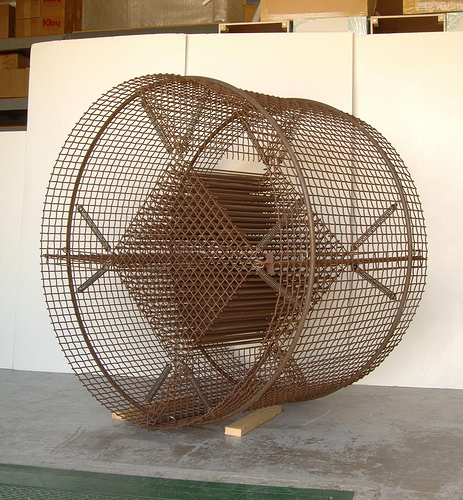
While at UNM, Beckman made formidable metal structures that seemed almost to have been engineered, so precise were they in their handling of materials and construction: clean and angular, objects rendered with industrial formality.
The work on display at the entrance to Nob Hill comes from a period of immense production in Beckman's career, as he was concluding his studies at UNM.
At the small community of artists where Beckman worked and studied in the late 1980s, many of the other students, myself included, were totally freaked out by the quality of Beckman's work. Hell, the faculty felt rightly flummoxed by the dude. He was way more talented than the old masters that ran the show.
Beckman fascinated everyone. The undergraduates who listened to the Descendents while pounding away on pipes and plates of steel in the metal shop wanted to buy him a beer at a watering hole called the Fat Chance Bar and Grill. Some gal from the ceramics division left a joint on his locker, sealed with a kiss made from a slip. The full professors waiting to hear from the biennial committee at the Whitney would walk around and around his output, adjusting their spectacles and clearing their throats.
I worked and studied with Beckman off and on, took his welding tips and wilting criticism because he was a nice guy and did not want to bullshit about this or that theory of postmodernism; he did not come off as pretentious or lofty and had the spirit of a working man.
Anyway, on the west side of the park, there is a bronze sculpture. Richard Beckman made the sculpure. It is called Star. I am not going to post a picture of Beckman’s construction because I want you to go take a look as soon as you can.
Beckman studied and taught at the University of New Mexico Department of Art and Art History when I was an undergraduate.
In his plain-spoken manner, Beckman was the real deal, authentic in a complex world of artists, those who wanted to be artists, and the adroit charlatans who sometimes tagged along for fun.
While at UNM, Beckman made formidable metal structures that seemed almost to have been engineered, so precise were they in their handling of materials and construction: clean and angular, objects rendered with industrial formality.
The work on display at the entrance to Nob Hill comes from a period of immense production in Beckman's career, as he was concluding his studies at UNM.
At the small community of artists where Beckman worked and studied in the late 1980s, many of the other students, myself included, were totally freaked out by the quality of Beckman's work. Hell, the faculty felt rightly flummoxed by the dude. He was way more talented than the old masters that ran the show.
Beckman fascinated everyone. The undergraduates who listened to the Descendents while pounding away on pipes and plates of steel in the metal shop wanted to buy him a beer at a watering hole called the Fat Chance Bar and Grill. Some gal from the ceramics division left a joint on his locker, sealed with a kiss made from a slip. The full professors waiting to hear from the biennial committee at the Whitney would walk around and around his output, adjusting their spectacles and clearing their throats.
I worked and studied with Beckman off and on, took his welding tips and wilting criticism because he was a nice guy and did not want to bullshit about this or that theory of postmodernism; he did not come off as pretentious or lofty and had the spirit of a working man.
One time, I volunteered to be part of a performance piece of Beckman's that was centered on a collection of steel objects he had crafted. He was
quiet, polite and focused, very measured throughout. On the other hand, I
danced around the sculptures in a bizarre new wave fashion heavily influenced by
hours of watching the movie “The Truth About De-evolution”. The next day one of
the professors stopped me in the hall. She told me she was fascinated by the
authenticity of my performance.
Incidentally, those performances took place at an art gallery called Raw Space. Raw Space was Downtown, in the place Anatolia Doner Kebab now occupies. At the time, Raw Space was a popular place for UNM art folk. I had a show of my shitty paintings there once and a band called the Ant Farmers played at the reception. One of the songs they played was called Shower Curtain.
Meanwhile, Richard Beckman graduated and went on to have a substantial career in the art world. He taught at the University of South Florida, exhibited widely, had public commissions and essays written about his work, which had taken a departure, had begun to explore organic and quasi-biological forms with the same honesty of spirit as his earlier forms.
I only know this because I did some research on Beckman for a magazine article I was writing. I also found out Richard Beckman died eight-and-a-half years ago.
Most of that '80s crap I wrote about at the beginning of
this essay—the gas station, the bar, the Peugeot and the wacky clarinetist
with spray paint and paisley stencils—have all but vanished. The sculpture lab
is pretty much the same though, down to the perplexingly aloof faculty and
buzz-saw swinging students, I reckon.
But Beckman’s work is scattered grandly, memorably across America; some of
it is here in this town. Go down to the place I told about and take a look. In
the rain, or anytime, forever, Beckman’s Star is wondrous.
Editor's Note: The sculpture pictured above is by Richard Beckman and was featured in the performance piece written about above. The photo was taken by Richard Beckman at UNM.
