02 April 2012
Things in Light Podcast #13: Walking the Wolf Mix
Unknown
4:14 PM
Albuquerque, Austin, Bigawatt, Great White Buffalo, Nambe, New Mexico, podcast, Sabertooth Cavity, Santa Fe, Tenderizor, The Grave of Nobody's Darling, The Kill Spectors, The Kleptones
Things in Light's thirteenth podcast, Walking the Wolf Mix, features recordings by The Kill Spectors, Bigawatt, Great White Buffalo, Tenderizor, Sabertooth Cavity, Venus Bogardus, The Grave of Nobody's Darling, and The Kleptones. See the full track listing below.
1. The Kill Spectors - Red River St.
2. Bigawatt - Concealer
3. Great White Buffalo - Hallraiser
4. Tenderizor - Rockweiler
5. Sabertooth Cavity - Kief Mountain
6. Venus Bogardus - Quien Es
7. The Grave of Nobody's Darling - Mary
8. The Kleptones - I See Rainbows (for Yoko)
27 March 2012
Jethro's Dawg
Rudolfo Carrillo
8:52 PM
By Rudolfo Carrillo
If you want to know about my dog, Rosie, then sit back awhile and I'll tell you all about her. First off, it is a damn miracle the dog is alive today, because when I found that mutt, she had a fractured pelvis, two broken teeth, and the bad attitude one develops after having been run over and then spun backwards onto the tarry asphalt by an SUV piloted by a former architecture student on his way to pick up his kids, late, from some daycare or other near the airforce base.
Now don't get me confused, as it weren't I that run her down and the fella that did was certainly polite enough before he left me there on the side of the road to look after her.
Rosie bit me through the hand when I approached and damn it if I didn't scream in agony and give a bloody finger to that nice man, as he headed south, in a hurry, on San Mateo Boulevard. I knew in my heart that la jura would show up at any minute and so set my mind to thinking how I was gonna get that angry heap of bones and fur out of the road before another truck rolled by and did her in. It came to me that I might as well take my shirt off, so that I could throw it over her head. But it was last day of summer and I was just starting to get my winter fat developed.
For a moment, I feared being seen in all my corpulent glory. But the hell with it says I, as I peeled off my top, yelled out an ancient Aztec battle cry and made my move. She didn't put up much resistance because she was plumb scared nearly to death, pobrecita.
At the emergency vet, they told me I ought to put her down, but I resisted, produced some Franklins from out my pocket and told 'em to do their best to save her. Those bills worked wonders and the next morning I got to take her home. The vets were glad to be shed of Rosie and told me she tried to bite just about every soul in the clinic. She was nice to me, though, and curled right up in the back of my 1987 Saab 900 for the ride home.
The year I found Rosie was the year my old man died and it so happened I spent the night waiting to hear about her fate by going to a New Mexico Symphony Orchestra concert where they played a thing called the Firebird Suite by a guy name of Stravinsky. I was using up the last of my father's season tickets and mostly thinking after him, how he was lying in a bed at the VA and dreaming of baseball and freedom and so forth and so on.
Well, my pops, who was also named Rudolfo, died that Thanksgiving. By then, Rosie had got herself healthy and plump and became the top dog at mi chante. She liked to follow me around and growled at anyone, kin included, that came near me.
I took her just about everywhere with me. She couldn't stand the folks I worked with, thought they were representatives of the devil, excepting one. That would be the quiet freelance music writer I had a secret crush on. Rosie the dog would wag her tail like it was dinnertime whenever that woman walked by my office.
Just about ten years have passed since all that came to pass. I lost my shitty sales job at that old place and went on to become what others call a formidable writer and artist. Just about everyone reads my mierda and thinks it is something fine, I hear. Off course, the most beautiful thing was I ended up married to the gal I told you about.
The only problem is with Rosie. She developed a sort of cancer during November of the warm winter that just passed. She has what they call a mast-cell tumor and it sure don't look good. The surgeon says he'd have to cut her leg off to cure the cancer, which the mutt told me was out of the question. He also said there was some hope for remission and so I am counting on that and keeping a close watch on her.
So, I've got her on prednisone and now it is springtime. Four months are a long time for a dog, I reckon. The trees in these parts are busy budding and today I saw that we've got bees in the back yard, just waiting for the apple blossoms to come out. And Rosie is sitting by my side as I type out this story. Her eyes are still bright. She still gets up every morning to visit with the sun and the sky, baring her teeth at anyone that stands between me and her.
And I don't know how this story I am telling you will end. I could guess at it all day and all night, if I was so inclined, and so might you. But, instead of pondering quantum outcomes, you all just keep her in your thoughts, as I am wont to do.
Be Seeing You.
14 March 2012
La Neta According to One Old and Trumpetlike Burqueño
Rudolfo Carrillo
11:37 PM
By Rudolfo Carrillo
I live in a magic world. Everyday, usually just after the sliver of earth upon which i reside slides celestially into the sunward position called daylight, I place a wizard's hat on my head. The hat is made from aluminum foil and has little black stars and crescent moons that I drew on it with a sharpie.
Once I have donned this arcane accoutrement of the brujeria practiced by outsiders, artists, punk-rock musicians, certain writers, as well as magicians of every conceivable level, from charlatan to time-lord, I walk ceremonially out into the town contained within the arc of land I told you about in the second sentence of this text-string. Out there in Albuquerque, leaves are erupting from the trees and the homeless people I share the bus with are leaving their jackets and blankets behind and wading in the Rio Grande, chasing after the ducks that stayed behind to feast on the shoots of fresh grass that are common and brightly supple as they grow in mid March on river's banks.
I decided to be a magician in the third grade, while my family was living in Gallup. My brother and I bought every magic trick you could come up with back then in the middle of the nineteen seventies and learned how to make them work. Our bag of incantations came from the Winrock Mall, from a place called Toys by Roy. We'd visit every weekend, when my folks drove into town and away from their lonely and spectacular outpost at the foot of the hogback mountain.
When we finally had a chance to perform before an audience, things went awry. Though my mother bought us wide collared shirts at JC Penny and made us capes from her mother's mystical trailer-house curtains, cards flew out into the space of the school auditorium like unfamiliar and wild butterflies and the silk scarves refused to change color. The rabbit got lost and never got to the venue. I think she ended up as a roadside attraction at Chief Yellowhorse.
Anyway, after all of that, and forty years later, I wander around this place, my New Mexican home, mi chante, el mundo, with the idea in my head that I am at least going to make a decent attempt to solve the great problems of humanity and the earth and all its creatures and plants, too. But since I am made of flesh I really can't do much. I can't cure cancer, for instance. Or find a way to mitigate genetically transferred autoimmune conditions. I know my limitations and they are woeful deficiencies to be sure, but life in the shadow of the unknowable has made me brave. Hope is my reliable weapon of choice, though one night I dreamt I carried a silver dorje on my back to scare away ghosts and demons.
Now, I am going to turn the volume down on the poetically satirical, yet plaintive post I just typed out for your consideration. I am going to be brave and tell you my opinion on some stuff, cultural items of the local variety for the most part, that I stumbled upon whilst skylarking, as above. If you don't like those words and ideas, then you can go to the devil. While you are chatting with old scratch, you might want to ask him for you own wizard's hat
- For starters, all this business about how Burqueños talk is bothersome to me. It was funny at first. But, like the episode of Gilligan's Island where the mad scientist accidentally transfers the spirits of Gilligan and the Skipper into a dog and a cat, it has worn thin with repeated iteration. Not all of us speak in funky malapropisms and vaguely defined terms. Those of us that do risk inflaming the souls of our ancestors for indulging in such stereotype-reinforcing mierda.
- There was a discussion on Duke City Fix (one of my former digital habitats, I must shamefully acknowledge) wherein two regular commenters bemoaned the state of affairs at this once noble cyber-destination. One said that the site "is circling the drain", while the other added "...the reason the site fizzled is because they took away the morning fix and regular blog posts and changed the format. Its not their fault, its a lot if time for non paying work." I am sure I said something similar when I channelled Criswell on this channel last summer. I'd like to add that said current circumstances are the products of poor creative and editorial choices. Combined with a slant towards so-called new comers and transplants (I'd employ the terms carpetbaggers and paternalistic orientalists here, but shall instead let my better angels guide my criticism) at the expense of local, native, and authentic voices, this has resulted in the rise in a bland and vanilla-flavored version of DCF which is haunted by wingnuts and characters from Portlandia. It seems a mockery of what I used to read five years ago.
- The Valencia County animal shelter is overwhelmed with stray dogs and had to kill an inordinate number of adoptable animals this past week. Listen, fellow humans, I know times are rough but I'd be mighty pleased if - when you get through that last curmudgeonly paragraph without condemning my flamy rant outright - just one of you would go out to your local shelter and adopt or foster a dog or cat. For one thing, that action of yours would help me stop crying tonight. For another, it would serve, to me at least, as proof of some sort of magic in this world.
Be Seeing You.
10 March 2012
The Day We Left Gallup
Rudolfo Carrillo
11:44 PM
by Rudolfo Carrillo
I am not aiming to elicit anything controversial here and so will use the word sparingly, in a manner opposite of my old man. He always prefaced his own lamentations in and with the press as "controversial" - and would bite his tongue and draw blood from it in a manner that unconsciously mimicked the pissed-off and forlorn priests of the aztec idol Huitzilopochtli - before warning his progeny of the news of his latest exploits.
When that solemn ritual was complete and after he had washed his hands with hot well water and Ivory soap, my father would offer up the local daily rag for immediate and familial perusal. This was mostly so his wife, sons, and daughter could gawk and twitter about this or that record of the fluidic and bellicose utterances made by the fat man from the sea about progress and urbanization. They were uttered in the beatific, bureaucratic patois of all federal employees hellbent on destroying the last remnants uncolonized America; a tone, a jargon, an intention that the sailor had mastered in his land-locked middle years.
His words were immortalized by the inky work of a group of scribes located in the smoky and lightly vodka scented newsroom of the Gallup Independent and we read them and just about every damn thing else in that collection of pages and words. We looked for meaning in that place and through that medium from the time I was about four until we left for Burque; those years came and went before I really knew what water was.
Here's a good one. The editor of that paper had a weekly column. It was called Up and Down the Perky. The "Perky" was what some folks out there called the mournful excuse for a river tributary that sometimes passed through town. I say it was mournful because the only time I can recall it being really perky was during the monsoon season. On those occasions, it would usually overflow and flood the north side of town. Besides that, the Perky also carried the heavy green leftovers of the mysteriously glowing giants' farms that were hidden here and there in the immediate vicinity.
That's why my old man was out in the western lands, why we were doing our thing in the shadow of the hogback mountain. He was part of a US government team that was going to design and deploy a sustainable flood control system for the city while also assessing and measuring the hot mess left behind by another US government team.
So, when Coronado's men walked through that part of the world - about four hundred and fifty years before the older version of Rudolfo Carrillo stood in his ranch style kitchen with avocado-colored appliances staring at the Gallup Independent with a scowl of disappointment on his mustashioed face - in the sixteenth century, they wept blood and anger, calling that ephemeral and unreliably wet ribbon of life el rio puerco. Then they probably watched the dirt and waited shamefully for their reflections to bubble upward from cracks in the dry earth and into the air, towards heaven.
They forgot about all those sly and nonsensical symbols of redemption and trod heavily, in grandiose costumes and metal suits, eastward to the big river.
In their absence and amidst the roaring vacuum created when one culture forcefully deconstructs another, only to be swallowed whole by the pale fish of western hegemony, I reckon that words like puerco became perky.
Anyway, the day we left Gallup, after my father's project ended in a drought year, the year of the small corn, my brother noticed a stagnant pool of water filled with hundreds of tadpoles setting across the street from our house. It was the end of summer and the rain was gone.
He asked me to help him. He wanted to drag the garden hose over to the little pond. He wanted to give the frog children a couple of extra days. We spent our final moments on the mesa giving temporary hope to a colony of doomed amphibians.
The hose was the last thing to go into the moving van. We drove away to Albuquerque. As we passed the Ciniza oil refinery, my father rolled down the driver's side window and removed some white feathers from his pocket. He let them flutter in the breeze before releasing them into the airy wake the car was making in its stormy progress along the interstate highway.
19 February 2012
Things in Light Podcast #12: Fauna Frequency Mix
Unknown
3:24 PM
Albuquerque, Bud Melvin, Dan K, Farmington, Kimnusico Trio, New Mexico, podcast, Reighnbeau, Sad Baby Wolf, Shiprock, These Charming Cobras, Vomit the Void Volume
Things in Light's twelfth podcast, Fauna Frequency Mix, features recordings by These Charming Cobras, Vomit the Void Volume, Dan K, Alan George Ledergerber, Kimnusico Trio, Bud Melvin, Reighnbeau, and Sad Baby Wolf. See the full track listing below.
1. These Charming Cobras - Stick and Pig
2. Vomit the Void Volume - Let's Go for a Ride
3. Dan K. - RÆCKS
4. Alan George Ledergerber - Toynbee Idea
5. Kimnusico Trio - Rasool's School of Music
6. Bud Melvin - Misty
7. Reighnbeau - Flutter
8. Sad Baby Wolf - 8th Level
18 February 2012
Aqui, Ahora, a Total Color
Rudolfo Carrillo
7:22 PM
1975, 2012, Burque, gasoline, Ghetto Smiths, gonzo journalism, metafiction, patience, Rio Grande, television, Val de la O
by Rudolfo Carrillo
While standing in the queue for the payment kiosk at ghetto Smiths bright and shiny new fuel depot attachment, a fellow with tiny eyes and sharp vocal articulation comes up to me and says "where the hell is the clerk", and "don't tell me they are starting this bullshit again". So, I smile and look up at him because I have been gazing deeply into the sunny reflection coming from my shiny leather shoes. He repeats himself and so I tell him the clerk is probably showing one of the customers how to pump gas or something like that. The guy tells me he hates New Mexico and that stuff like the missing cashier is why he moved away fifteen years ago, but then finishes off by saying he has come back for a year to teach a course over at the university. I go back to shoe-gazing and the clerk ultimately ambles back into the booth, smelling of gasoline and low wages.
After I pay my seven bucks for about two gallons of gas, I tell the man behind me to have a nice day. He is so busy arguing with the clerk that he probably doesn't hear me.
I didn't think much of it, except I thought the story might make a good introduction for another post about my experience of events while living in Burque. Of course I'd probably come up with some abstruse way of putting that out to you, like pretending, for instance that I am some sort of emissary from another world, downloading data to the robots or colonists or whatever fictive beings I could come up with, in order to spice up the story.
Anyhow, this sort of device is just what I came up with with regards to the past.
Listen up and draw yourselves to the fire for these words, pilgrims because the way I spill them out into the air and onto the page will one day be described as part of a great confluence of data transmission protocols originating on the planet earth and produced by fragile, flesh-bound beings whose various constructions survived their incorporation as individual biological units. This is part of what will inevitably be left behind. Though there is no permanent record of its passage through your optic nerve and into the universe that you are bound to with water and carbon, its potential to be assimilated, decoded and analyzed by other entities, even billions of years from now, has quantum possibilities.
To further investigate this phenomena, I jumped back to a sub-location in the aforementioned spacial membrane. Called nineteen-seventy five by the beings passing through it, the place is rich with data sources.
At our primary research station, deep at the bottom of the Rio Grande, at the research and colonization center described in a previous iteration of this report, I happened upon the following recorded fragment of an electromagnetic broadcast. For research purposes, it has been uploaded to devices common in the current temporal location, as many of my associates still have not updated their terminals to include basic reverse time-travel apps (damn imperial bureaucracy).
After rigorous analysis of this artifact, I have decided to elucidate my findings using the linguistic structures common to our subjects.
I love New Mexico, this is one of the reasons I stay here. Es la neta.
End Transmission.
12 February 2012
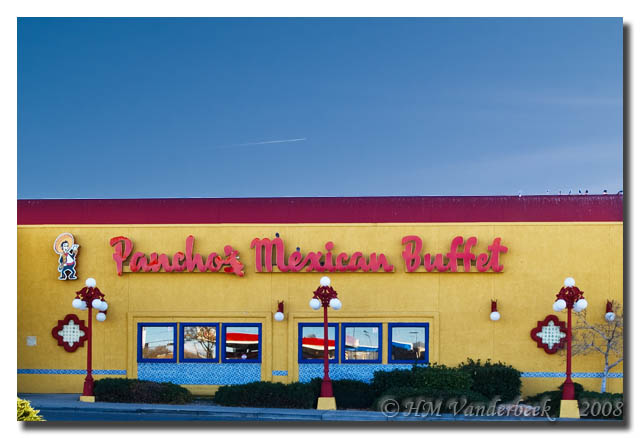
Two Concatenated Excerpts from Restaurants That Do Not Exist
Rudolfo Carrillo
11:13 AM
Albuquerque, animals, Christmas, colonization, datura, food, green chile, Montana Mining Company, Pancho's Mexican Buffet, red chile, restaurants, Shakey's Pizza, water
Introduction: Loomings
Begin transmission.
As extra-Venusian research
continues on our distant and watery celestial neighbor, I find it necessary to
elucidate the following anecdotal data. It is fervently hoped that such
information, if properly disseminated, will result in the continued, though
oft-maligned interest in our inevitable and glorious conquest of the third
planet.
On that world, in the anomalous
expanse of desert initially surveyed by our predecessors as a place of
potential colonization (prior to the advent of instantaneous multi-dimensional
communication), there are numerous human settlements concentrated along a
narrow band of liquid, mostly potable water, known to some as a river and to
others as el rio.
Linguistic variations aside, inhabitants
of the area commonly refer to this geologic phenomenon using adjectives
alluding to its immensity, although many are quite aware of the irony such
descriptions invoke.
One of the larger settlements in
this region is known as Albuquerque, New Mexico.
More than three quarters of a
million sentient beings (non-inclusive of the millions of dogs and cats who are
surreptitiously working with our clandestine forces toward colonization) occupy
this complex network of buildings, roadways, agricultural areas and other
planned structures, situated at the edges of said river and sprawled out
wantonly, along its course to the sea. The settlement also diffuses eastward to
a series of large granite outcroppings whose names refer to fruit or
fruit-bearing plants and thereby allude to the importance humans place upon the
sustained production and consumption of food.
Recently, this place called
Albuquerque has also spread westward, out into a desiccated plateau.
Interestingly, this area of relatively new activity does not bear a name
suggesting or alluding to the edible parts of vegetative growth. Its leathery
dryness is supplanted by importing water from the narrow and beckoning stream
detailed above, or by drilling deeply into the earth itself, tapping the underground
aquifer which sleeps temporarily beneath the city.
The production and consumption of
food and the consequent need to maintain a sustainable water supply to
facilitate such frail activity seems to hold a preternatural fascination among
the current inhabitants, who, by the way, refer to themselves variously as
Albuquerqueans, Burqueños or pinche carpetbaggers.
Besides its notable presence in the
naming of physical landmarks, this inherent interest in food (Burqueños and
their "pets" must eat to live, unlike the misty and non-corporeal
beings found in the void surrounding their planet) and its numinous
associations may be seen in the naming of specific meals utilizing the fruit of
the much adored chile plant.
The highly prized berries of this
relative of nightshade, datura and potatoes are lovingly and gloriously cooked
and eaten when either red or green coloured. Separately, each has a fervent
following; when presented together however, a ritual religiosity may be noted.
Consumers refer to that interaction as “Christmas”, ascribing to the
consumption of the two the name of an important winter holiday which apparently
celebrates the potential for the divine within the strictly corporeal.
Further examples of this tendency
to associate divinity with the native cuisine have been widely reported. The
spontaneous manifestation of holy images on another deeply revered foodstuff,
the tortilla, have been carefully and precisely documented.
In order to continue this important
line of research and make a determination about the probable connections
Albuquerqueans have to the sublime nature of the universe - and therefore their
amenability to colonization - it is highly recommended that this researcher be
given time and opportunity to investigate the templar edifices where such rites
of consumption are known to take place. It is felt that, in these lofty
locations, known locally as “New Mexican Restaurants” or “Restaurantes Nuevo
Mexicano”, important observational discoveries regarding the nature of this
group of humans residing in the desert may be made.
I would also like the opportunity
to examine the coming water crisis these humans or their successors will one
day face. They need the water to perpetuate the cult of chile and the temple of
tortillas, as I have affectionately come to call this cluster of cultural units
- though it has come to me through my handlers (such as they are at this most
distant and dusty outpost of the empire) that after initial contact is made, we
may direct esta gente towards the moon, as a reward for being compliant.
Part One: The Carpet Bag
So it's Saturday afternoon
in the duke city and I'll be good and god-damned if I can no longer take my
life into my own hands by driving north on San Mateo Boulevard for lunch or
dinner at Pancho's Mexican
Buffet. The pinche place is closed and that closure has been
announced in the classic Burque fashion for businesses in these parts that have
given up the ghost. Someone left a ragged piece of notebook paper taped
crookedly to the door with the word closed scrawled upon it in black nail
polish.
No one is answering the phone over yonder,
either, so I am sure it is over. I know most of you are okay with that and I
will be the first one to admit that Pancho's had seen better days. The chile
rellenos had gotten dull and mealy. Who could possibly take pleasure in raising
a flag that brought anxious eaters sopapillas that had been repeatedly reheated
in la microondas?
Visits there had always
been an exercise in sentimentality, anyway. Really, I'd only been to the
northeast heights incarnation of Pancho's a few times. I mostly used those
visits as a reference point for remembering their main location on Central and
San Pedro. I had fond memories of that dive and would still stop to raise the
flag long after it became run down and drunks from MG's Grand Liquor or Foxes Booze and
Cruise wondered blindly through the parking lot or passed out in
front of the take-away entrance.
Ultimately, I'll have to
add Pancho's Mexican Buffet to the list of Albuquerque restaurants I shall,
alas never dine at again. There are a lot of those, but if you wanna know the
ones that really break my heart, I thought I'd finish out this essay with a
short list. Try not to languish in despair as you peruse the following fateful
outline.
Of course, it nearly killed me when Shakey's Pizza left town.
Try as I might, I've never been able to recreate the sublime experience
encountered when presented with thin crust pizza, bright green-colored soda pop
and continuously screening Laurel and Hardy shorts. When I was really young and
unaware of the mechanical nature of the universe, I was convinced that the
player piano in the corner was haunted.
In high school, I took a girl I was dating to the Morning
Glory Cafe, because I heard it was a hip joint. It was musty, smoky and filled
with dirty hippies, but they had a hell of a grilled cheese sangwich and coffee
refills were free, too. There were always interesting treasures crammed under
the seat cushions in that place. I ended up breaking off the affair with that
young woman, who I recall was named Patricia. That was a sad time, but I
assuaged my aching soul with a copy of Zap Magazine and an authentic coin from
Cuba that I had hauled out of the boothy abyss where we sat.
Goody's was the local diner where every table-top featured
its own toaster. Those bright and shiny electronic symbols of consumer
convenience became harbingers of doom, ultimately. Daring citizens with mouthy
appetites and a distinct lack of scientific or entrepreneurial oversight began sticking
forks in the damned things, trying to retrieve their golden prizes early. I
still have the university ID from my freshman year to testify to that fact;
it’s the only record that remains of my youthful experiments with curly hair. Enough said.
Speaking of my undergraduate years is painful enough,
especially given the fact that I went to art school at UNM at a time when Joel
Peter Witkin was still sleuthing the hallways for new models and their pets.
That authentic aesthetic despair was only heightened by the demise of the The Purple Hippo
Ice Cream Parlor on Harvard. It will forever be sorely missed. In
particular, I languish over my consequent inability to get a decent corn or
wood flavored ice cream cone in this town.
Growing up on the Rez, we got used to and were familiar
with folksy joints that had names like Earl’s or the Ranch Kitchen, so
permanently trucking the entire Carrillo family out to the faraway and
exotically bifurcating urban arcadia that we imagined Burque to be was a font
of amazement for sublime and indescribable gastronomic fascinations.
In trying to reconcile that transformative experience with
the my current engagement with hyper-local cuisine, I recall The Spaghetti
Machine, a dark, multi-level universe of pasta dishes whose realm was also
filled with first-generation video game consoles and servers who wore red cloth
napkins on their heads, perhaps as an indication of their participation in the
creation of my future. Or something like that.
And then there was the Big Valley Ranch Company, a top-tier
steakhouse on Menaul. Someone with a huge brain, perhaps from the same world
that had telegraphed Herman Cain into the American restaurant scene, came up
with the absolutely brilliant idea for this garden of eatin’. They had devised
a floor plan wherein each of the tables were enclosed in separate, discrete
plexiglass cubes. I was astonished at first, but after eating there a few times
with the old man, began earnestly praying that the same folks would take over
Earl’s and the Ranch Kitchen too - mostly because of the mental abuse I had
suffered in those roadhouses when witnessing local sheep-hands dig into their
mutton-head stew with a carnality and exuberance that I was convinced was
demonic, or at least very sloppy and ill-mannered.
There are
plenty of eldritch and woeful tales concerning the long disappeared and
potentially possessed eateries I have been in contact with over the years, here
in Burque and beyond. I would yet reveal them to this genteel audience, but I
note that the clock I am carrying in my pocket is now indicating that
snack-time is nigh.
End
Transmission.
25 January 2012
ABQ MTV: Black Swans, Meatheads, and Chance
Unknown
6:51 PM
ABQ MTV, Albuquerque, DÆRK, Farmington, music videos, New Mexico, Saint Karen, Teetotum
Things in Light is pleased to present the fifth episode of ABQ MTV.
►▶▸
via Moldspores — Watch live video of Teetotum performing at Small Engine Gallery on Jan. 11, 2012.
►▶▸
This selection is definitely biased, because Saint Karen is a friend and I'm also a big fan of her art.
►▶▸
DÆRK's video for "BÆÆCH" has a kvlt, Black Swan vibe.
16 January 2012
A Selection From the Wide Valley of Hope and Order
Rudolfo Carrillo
9:43 PM
Albuquerque, Burque, Corrales, history, Las Cruces, New Mexico, northeast heights, Territorial House
by Rudolfo Carrillo
As it turns out, the history of this state, even rendered and distilled into an extra-complex and viscous fluid of strategies as I have previously employed here, is dang popular. People like to read about stuff that happened to people who came out onto the earth in these parts before we were around.
With that concept in mind I turned the wheels in my head loose, locating all the odd stories that I heard from my old man and his kin, plus the stuff I experienced here, so far, myself.
Rambly as all of that may be - and it may get that way on purpose, just to swirl you around into all the different worlds and different places that I can construct with a finite set of alphanumeric characters - its mostly stuff that really happened.
Combined with an embedded set of ideas in each of my readers' heads about how to decode and organize those text-strings, the result, as any carnival barker will tell you, is to inform, amuse and perplex. It is no joke that I hope you all get something close to magic from said interaction.
So I am going to start with nineteen forty-five and wind my may through to the summer of nineteen seventy-five, before I drop you off somewhere about Christmastime, nineteen ninety-five.
After the war was done my father and his brother, their cousins who lived, and the friends who they grew up with, came home to Las Cruces. Even the ones lucky enough to be physically whole had been changed; whatever came before seemed ghostly and unkempt. Now they were thin restless souls returned to the desert, to a place of elusive order where some plants took forty years to bloom.
Men like this were scattered through New Mexico like the seeds of a new commodity, each mixed thoroughly into the rich soil of rediscovered locality and regional potential. Their assimilation into american culture and the economic success such entailed was anxiously informed by the military culture they brought back to reside with them in their flinty and orderly hearts. It was in the quick cinderblock ranchitos that appeared with waxen spontaneity on the edge of town; it was in the smooth concrete, built up from the sand next door and the river down below - deposited lovingly, but certainly as an intricate cover too - masking what remained of the past, dry and crummy as it was, had been, or was imagined to be.
There were demonstrations of American exceptionalism and what had been woven into their wartime souls poured out into their lives on the mesa. On more than one occasion, they trucked in trees from California and the new vegetative entities bloomed and otherwise professed greenness and fruition all damn year long.
Along the northern passage and in the midst of la jornada del muerto, immense reservoirs had been constructed so that once abandoned nautical fantasies could be pleasantly revisited, every weekend, ad infinitum. From those driftingly buoyant castles, they dreamt of Burque. To my people that place danced on the horizon like a daikini possessed by an atomic grandeur that could only possibly yield meaning through communion.
Assuming the measure of control desired and to some degree attained by the post-war prodigals, it is a wonder that any chaos crept out of all that beauty and strength and yearning, to walk down the bright boulevards and through the tamed tropical replicas, howling and mournful, as misadventure is wont to do.
But that's what this story is all about, now that I come to think on it.
You see my folks weren't the first to creep hopefully and by moonlight towards the fabled and fabulously well-to-do El Norte.
My old man 's sister Cuca married a restless and pugnacious state cop named Robert Gilliland. They settled in the northeast heights during the mid nineteen sixties. Their kids went to Sandia High. We were there too, mostly on the weekends, staring out at the arcadian world which surrounded them, gracefully and efficiently.
By the time the decade turned, Gilliland had grown disenchanted with the kind of law enforcement that happened along the state's highways. He retired honorably and bought a restaurant in Corrales.
The place was called the Territorial House. Besides the full-on biker bar that sat on the corner of the lot, the property had a notorious reputation. Two men had died there in a gun battle back in 1898. The cottonwood in front by the road was well-known to old-timers as a hanging sort of tree.
But the place was successful; Robert and his business partner, Monie Sanchez, ran a tight ship, pouring their restive hearts into it every night, dreaming by day of controlling this world and that one.
In the summer of nineteen hundred and seventy-five, two men entered that bar I told you about. Some say they came to rob, others said their motives were more vengeful and complex than that. In any case, gunfire erupted while Sanchez was at the cash register and my uncle was in a back room. The assailants fled from the critically wounded man, but were unusually calm and collected, walking back to their car in the parking lot, unaware of Gilliland, who grabbed a shotgun from under the counter, followed the men out and shot them to death where they stood, with the engine running and the AM radio blaring.
Robert Gilliland walked inside and called the police. Then, he dialed up my old man and breathlessly told him everything before he collapsed on the floor and died of a massive heart attack.
Twenty years later, when I was working a slacker job at an art supply shop in Nob Hill, the boss chose the Territorial House for the company Christmas dinner. At the time, the joint was called Rancho de Corrales, but the bar was still there, the tree, too. I took my brother along and we were both mighty uncomfortable during the proceedings. The fellow that ran the art shop, Ernie, was just as confused as could be about all that, especially when all we could do was mumble about how clean and organized the whole place seemed to be. Sure, there were ghosts lurking there, but you wouldn't a known it by the way the art store people carried on that night.
As it turns out, the history of this state, even rendered and distilled into an extra-complex and viscous fluid of strategies as I have previously employed here, is dang popular. People like to read about stuff that happened to people who came out onto the earth in these parts before we were around.
With that concept in mind I turned the wheels in my head loose, locating all the odd stories that I heard from my old man and his kin, plus the stuff I experienced here, so far, myself.
Rambly as all of that may be - and it may get that way on purpose, just to swirl you around into all the different worlds and different places that I can construct with a finite set of alphanumeric characters - its mostly stuff that really happened.
Combined with an embedded set of ideas in each of my readers' heads about how to decode and organize those text-strings, the result, as any carnival barker will tell you, is to inform, amuse and perplex. It is no joke that I hope you all get something close to magic from said interaction.
So I am going to start with nineteen forty-five and wind my may through to the summer of nineteen seventy-five, before I drop you off somewhere about Christmastime, nineteen ninety-five.
After the war was done my father and his brother, their cousins who lived, and the friends who they grew up with, came home to Las Cruces. Even the ones lucky enough to be physically whole had been changed; whatever came before seemed ghostly and unkempt. Now they were thin restless souls returned to the desert, to a place of elusive order where some plants took forty years to bloom.
Men like this were scattered through New Mexico like the seeds of a new commodity, each mixed thoroughly into the rich soil of rediscovered locality and regional potential. Their assimilation into american culture and the economic success such entailed was anxiously informed by the military culture they brought back to reside with them in their flinty and orderly hearts. It was in the quick cinderblock ranchitos that appeared with waxen spontaneity on the edge of town; it was in the smooth concrete, built up from the sand next door and the river down below - deposited lovingly, but certainly as an intricate cover too - masking what remained of the past, dry and crummy as it was, had been, or was imagined to be.
There were demonstrations of American exceptionalism and what had been woven into their wartime souls poured out into their lives on the mesa. On more than one occasion, they trucked in trees from California and the new vegetative entities bloomed and otherwise professed greenness and fruition all damn year long.
Along the northern passage and in the midst of la jornada del muerto, immense reservoirs had been constructed so that once abandoned nautical fantasies could be pleasantly revisited, every weekend, ad infinitum. From those driftingly buoyant castles, they dreamt of Burque. To my people that place danced on the horizon like a daikini possessed by an atomic grandeur that could only possibly yield meaning through communion.
Assuming the measure of control desired and to some degree attained by the post-war prodigals, it is a wonder that any chaos crept out of all that beauty and strength and yearning, to walk down the bright boulevards and through the tamed tropical replicas, howling and mournful, as misadventure is wont to do.
But that's what this story is all about, now that I come to think on it.
You see my folks weren't the first to creep hopefully and by moonlight towards the fabled and fabulously well-to-do El Norte.
My old man 's sister Cuca married a restless and pugnacious state cop named Robert Gilliland. They settled in the northeast heights during the mid nineteen sixties. Their kids went to Sandia High. We were there too, mostly on the weekends, staring out at the arcadian world which surrounded them, gracefully and efficiently.
By the time the decade turned, Gilliland had grown disenchanted with the kind of law enforcement that happened along the state's highways. He retired honorably and bought a restaurant in Corrales.
The place was called the Territorial House. Besides the full-on biker bar that sat on the corner of the lot, the property had a notorious reputation. Two men had died there in a gun battle back in 1898. The cottonwood in front by the road was well-known to old-timers as a hanging sort of tree.
But the place was successful; Robert and his business partner, Monie Sanchez, ran a tight ship, pouring their restive hearts into it every night, dreaming by day of controlling this world and that one.
In the summer of nineteen hundred and seventy-five, two men entered that bar I told you about. Some say they came to rob, others said their motives were more vengeful and complex than that. In any case, gunfire erupted while Sanchez was at the cash register and my uncle was in a back room. The assailants fled from the critically wounded man, but were unusually calm and collected, walking back to their car in the parking lot, unaware of Gilliland, who grabbed a shotgun from under the counter, followed the men out and shot them to death where they stood, with the engine running and the AM radio blaring.
Robert Gilliland walked inside and called the police. Then, he dialed up my old man and breathlessly told him everything before he collapsed on the floor and died of a massive heart attack.
Twenty years later, when I was working a slacker job at an art supply shop in Nob Hill, the boss chose the Territorial House for the company Christmas dinner. At the time, the joint was called Rancho de Corrales, but the bar was still there, the tree, too. I took my brother along and we were both mighty uncomfortable during the proceedings. The fellow that ran the art shop, Ernie, was just as confused as could be about all that, especially when all we could do was mumble about how clean and organized the whole place seemed to be. Sure, there were ghosts lurking there, but you wouldn't a known it by the way the art store people carried on that night.
07 January 2012
A Mythology for Southern New Mexico
Rudolfo Carrillo
2:41 AM
centennial, Chihuahuan desert, Clyde Tombaugh, EEUU, New Mexico, Spanglish, UFOs, White Sands Missile Range
by Rudolfo Carrillo
Oye, compañeros, it's like the new year and stuff, but la neta is that I was just as unprepared for this unique ubicación on the space/time continuum as were you. Although los preparados amongst you might be making un gran chiste out of this clumsy attempt at post-event accountability, it does go without saying that the passage of years loses its gradual quality as the sun continuously swallows up whole days while la tierra is alternately consumed by darkness and engulfed in starshine; a sliver of a celestial sphere reborn brightly and eternally every dawn.
Given that sort of cosmology as a guiding force, and whilst referencing the centennial year of this here state, (cien años, que chingon!) I reckon I could use this textual timeframe to traverse the chasm of years that have passed since I first appeared, unannounced and similarly perplexed, in a raggedly settled portion of the Chihuahuan desert which perpetually looked covetously south towards home.
That was, more or less, quarenta-ocho years ago. Though I've only been around for roughly un medio of the time este lugar has been part of the EEUU, I've tried to pack in as much acción as possible, and let me tell you, just getting here was a trip, carnales.
Mi jefita, Virginia, had to travel from Las Cruces down to the rocky and forlorn colonial outpost known to some as El Paso del Norte, in my grandpa Albino's Bel Air because she was pregnant and the hospital in the Mesilla valley did not quite have the facilities or faculties to deal with a case like hers.
Que bárbaro!
Listen, it went something like this: Virginia was an educated young Nueva Mexicana, an identity she worked hard to attain, but which was still rare, fifty years después de statehood.
Anwho, ella worked for a fellow named Clyde Tombaugh, down at New Mexico State University. In case you are interested, he was the hombre que descubrió la planeta se llama Pluto. He did this in 1930 while working in Arizona, but by the mid-sixties he was dividing his tiempo between Aggieland and White Sands Missile Range, where he consulted on various military projects.
My mom was one of his assistants. Mostly she took dictation from him on his various proyectos. Besides going on and on about this planet and that natural or artificial satellite, Tombaugh had an overwhelming interest in UFOs and extraterrestrials, which he passed on to Virginia via scribbled notes and field recordings.
Anyway, debido a la tensión y la intensidad del trabajo de Virginia, her doctors decided not to tell her that there were really two babies on the way. What with all the talk about flying saucers, atomic weapons, and newly discovered astronomical bodies, she had enough to worry about, pobrecita!
But when she inadvertently got la neta from her nosy hermana Joann in the early summer of the year mil novecientos sesenta quatro, she threw her precious copy of A Hard Day's Night against the wall in frustration, shattering it into a million shiny shards and causing the framed photograph of John F. Kennedy hanging on the wall to tilt out of balance, to the right.
Virginia borrowed the car from her suegro, Albino, who happened to be nearby. He was busy turning a small plot of desert land into a tropical paradise, complete with peacocks, and so handed her the keys, absentmindedly. So she drove herself to a place called Hôtel-Dieu and went into labor.
Hôtel-Dieu: that's what they called the main hospital there in Borderville. I'm serio güey, look it up.
Well, my old man found out about all of this about una media hora más tarde and went after her in a state police car (just like the kind they had in la pelicula se llama Them!) driven by a jura buddy of his. Serio. On the way there, el amigo crashed the car and aced himself. My old man punctured his right lung and ended up in the same Frenchily named hospital as my mom.
Luckily, we weren't born until the next morning, when things had mellowed out un pocito. It was July and el sol was already brightly burning up the sky and surrounding desert, pero todos estaban sonriendo and the light was welcome. Some of la familia sat quietly reflecting, while others leaned out of windows in the hallway, smoking. Men and women in labcoats and in uniform and also in black bowties briefed Virginia on my father's prognosis, los gemelos, y le susurró a ella sobre los lights in the sky that Tombaugh had reportedly seen from his observatory en la noche pasada.
Pos, eso es lo que he oído. Most the people that lived in the text strings that I generated here and above have returned to the earth, so you can't really ask them, unless your centennially enhanced brujería is really happening. The ones that remain will probably be taciturn, I gotta tell you. It's in their nature.
Oye, compañeros, it's like the new year and stuff, but la neta is that I was just as unprepared for this unique ubicación on the space/time continuum as were you. Although los preparados amongst you might be making un gran chiste out of this clumsy attempt at post-event accountability, it does go without saying that the passage of years loses its gradual quality as the sun continuously swallows up whole days while la tierra is alternately consumed by darkness and engulfed in starshine; a sliver of a celestial sphere reborn brightly and eternally every dawn.
Given that sort of cosmology as a guiding force, and whilst referencing the centennial year of this here state, (cien años, que chingon!) I reckon I could use this textual timeframe to traverse the chasm of years that have passed since I first appeared, unannounced and similarly perplexed, in a raggedly settled portion of the Chihuahuan desert which perpetually looked covetously south towards home.
That was, more or less, quarenta-ocho years ago. Though I've only been around for roughly un medio of the time este lugar has been part of the EEUU, I've tried to pack in as much acción as possible, and let me tell you, just getting here was a trip, carnales.
Mi jefita, Virginia, had to travel from Las Cruces down to the rocky and forlorn colonial outpost known to some as El Paso del Norte, in my grandpa Albino's Bel Air because she was pregnant and the hospital in the Mesilla valley did not quite have the facilities or faculties to deal with a case like hers.
Que bárbaro!
Listen, it went something like this: Virginia was an educated young Nueva Mexicana, an identity she worked hard to attain, but which was still rare, fifty years después de statehood.
Anwho, ella worked for a fellow named Clyde Tombaugh, down at New Mexico State University. In case you are interested, he was the hombre que descubrió la planeta se llama Pluto. He did this in 1930 while working in Arizona, but by the mid-sixties he was dividing his tiempo between Aggieland and White Sands Missile Range, where he consulted on various military projects.
My mom was one of his assistants. Mostly she took dictation from him on his various proyectos. Besides going on and on about this planet and that natural or artificial satellite, Tombaugh had an overwhelming interest in UFOs and extraterrestrials, which he passed on to Virginia via scribbled notes and field recordings.
Anyway, debido a la tensión y la intensidad del trabajo de Virginia, her doctors decided not to tell her that there were really two babies on the way. What with all the talk about flying saucers, atomic weapons, and newly discovered astronomical bodies, she had enough to worry about, pobrecita!
But when she inadvertently got la neta from her nosy hermana Joann in the early summer of the year mil novecientos sesenta quatro, she threw her precious copy of A Hard Day's Night against the wall in frustration, shattering it into a million shiny shards and causing the framed photograph of John F. Kennedy hanging on the wall to tilt out of balance, to the right.
Virginia borrowed the car from her suegro, Albino, who happened to be nearby. He was busy turning a small plot of desert land into a tropical paradise, complete with peacocks, and so handed her the keys, absentmindedly. So she drove herself to a place called Hôtel-Dieu and went into labor.
Hôtel-Dieu: that's what they called the main hospital there in Borderville. I'm serio güey, look it up.
Well, my old man found out about all of this about una media hora más tarde and went after her in a state police car (just like the kind they had in la pelicula se llama Them!) driven by a jura buddy of his. Serio. On the way there, el amigo crashed the car and aced himself. My old man punctured his right lung and ended up in the same Frenchily named hospital as my mom.
Luckily, we weren't born until the next morning, when things had mellowed out un pocito. It was July and el sol was already brightly burning up the sky and surrounding desert, pero todos estaban sonriendo and the light was welcome. Some of la familia sat quietly reflecting, while others leaned out of windows in the hallway, smoking. Men and women in labcoats and in uniform and also in black bowties briefed Virginia on my father's prognosis, los gemelos, y le susurró a ella sobre los lights in the sky that Tombaugh had reportedly seen from his observatory en la noche pasada.
Pos, eso es lo que he oído. Most the people that lived in the text strings that I generated here and above have returned to the earth, so you can't really ask them, unless your centennially enhanced brujería is really happening. The ones that remain will probably be taciturn, I gotta tell you. It's in their nature.
Type text or a website address or translate a document.
03 January 2012
Things in Light Podcast #11: Moon-bleached Mix
Unknown
4:14 PM
Alan George Ledergerber, Alchemical Burn, Chemtrail Pilot, DÆRK, Dan K, New Mexico, podcast, The Scrams, Venus Bogardus, Vomit the Void Volume, William Fowler Collins
Ansel Adams' Aspens, Northern New Mexico, 1958
Things in Light's eleventh podcast, Moon-Bleached Mix, features recordings by Alan George Ledergerber, William Fowler Collins, Vomit the Void Volume, Alchemical Burn, Venus Bogardus, Dan K., The Scrams, DÆRK, and Chemtrail Pilot. See the full track listing below.
1. Alan George Ledergerber - Soft Despotism
2. William Fowler Collins - Foothills' Ghost
3. Vomit the Void Volume - I'm Lost
4. Alchemical Burn - When Doves Cry
5. Dan K. - Dying Sunshine
6. Venus Bogardus - The G-Boys
7. The Scrams - La Llorona (Speak Onion Remix)
8. DÆRK - INFÆRNO
9. Chemtrail Pilot - Somnambulism
24 December 2011
Carrillo's Holiday Ruminations, Part Forty-Eight
Rudolfo Carrillo
12:12 AM
by Rudolfo Carrillo
For some of these posts at Things in Light, I like to pretend that I am some really old and cantankerous guy who is looking back and then writing about things in el Burque from either the command center of a fairly complex time-travel/star cruiser parked at Tingley Beach and available to all local citizens in the year 2036, or, alternatively, from the back of a gasoline and rust-soaked 1968 Chevy El Camino that I end up living out of at Milne Field after the economy finally and utterly collapses.
Take your pick cause it's cold out there and I don't like the idea of you standing there, shifting from foot to foot on the cold concrete while you try to decide whether to read any more of this special Things in Light holiday blog post. I mean I could be writing undecipherable, paranoia-tinted sci-fi, but with old man winter howling around my front door, I gotta admit that I am in the mood for folksy and hope that you are too.
This season features a pale southern sun; that light has a certain thin fragility to it, like what's inside a dragonfly wing, or the wrapping tape from last year's gifts. The clouds and their produce mask whole geographies and are one of the few earthly phenomena that can make this place seem contained.
So, winter is damned poetic in these parts; a million times more poetic than any text or graphics-based representation I could come up with here. I'd be better off and more truthful as an artist too, if I invited you to go outside and take a walk around in it. If you do that, I'll step out the front door for a quick puff of tobacco, a mild stimulant which I prefer to use exclusively when turning sticks into RAM.
I told you it was cold out there. It is so cold that Samantha's miniature pug, Hannah, refuses to go out after dark. She just pissed on the kitchen floor for the third time this week and is obviously relying on her innate evolutionary advantage (perpetually small, bug-eyed cuteness) to get away with what would be seen as an abomination if practiced by my other dogs. During the sunny days just past, Hannah ran around in the backyard - soaking up the sun in the glad but awkward fashion of a tiny alien dog-creature sent to wreak havoc on the planet Earth -- for hours at a time. But at night lately, it's the same messy failure to launch. I am beginning to think her fear of the cold has a previously undetected co-efficient contributing to its intensity.
It could be all manner of things. But what if the little dog, who is all ears and nose -- and because of her size and position in the universe is imbued with a threat-recognition system that probably rivals that of any number of small Middle-Eastern democracies -- senses a predator out there in the winter night?
I've lived in Ridgecrest for going on 12 years. I've seen a few raccoons, three coyotes, a number of small hawks and burrowing owls, but never any large raptors. I can imagine that large owls, eagles and mammalian predators occasionally forage for prey between the mountain and the bosque too, slinking through town and taking pets when there aren't any healthy rodents afield.
I am convinced this fleshy deficit is partly due to the seed and grain withering drought currently manifesting itself in the upper Chihuahuan desert. Most scientists are convinced that the dryness is the result of global warming caused by large scale human industrial processes.
So if Hannah gets snatched by a displaced predator, I am going to blame every last one of you unprincipled consumers currently driving around and around Nob Hill, looking for parking that is comfortably close to your favorite locally-owned, Chinese-supplied boutique. I am only sort of joking because it will never come down to that anywho.
When I do get la perrita to go out at night, I turn on a couple of lights and send Samantha's other dog, Schrodinger, out with her. He is orange and weighs about 100 pounds, with jaws made from a compressed and weighty metal spring. Mangy old coyote wouldn't stand a chance, plus the hound fancies bird meat, sabes?
So that's pretty much an accurate record of what I was thinking about last night. I let this post sit until the next afternoon, trying to decide whether it was mierda or not. I ended up thinking it was a sorta funny vignette of local experiencas en Burque, and decided to let it fly.
Before I toss this bit of paper into the wind though, here is one more situation I ran into today at the notorious Walgreens on Central and San Mateo. If you are wondering why I refer to the pharmacy as notorious, then you need to park your car and sit in their parking lot with feigned nonchalance for five minutes, as soon as is convenient.
So the guy in front of me at the cash register queue has a shopping cart of supplies to make luminarias. Bags, candles, sand, the whole enchilada, as it were. He was in his late twenties, well-dressed maybe from out of town, visiting or something. There is also an old woman behind me. She has a bag of Payaso brand Cheese Puffs in one hand and a bottle of mountain dew and her EBT card in the other. She looks over my shoulder at the guy hauling the cart of potential holiday mirth and starts cussing him in Spanish, telling him how its her tradition and that he is stealing it, and its all very shameful, et cetera.
This doesn't play to well with the young fellow, his reaction shows he doesn't understand la idioma. He starts to shift uncomfortably from foot to foot, like he is standing by the front door in the middle of winter and it is cold and he forgot his shoes by the fire.
Suddenly a rather large hawk descends from the ceiling and carries him away. I have to stand out of the way so I don't get clipped by the enormous wings.
The woman who called out in Spanish laughs and laughs until her head comes off.
Back in meatspace, I drive home and watch an old film I bought at the pharmacy. It is called Zulu and features the acting talents of Michael Caine. It's supposed to be about war, but really its about the relationships between race, economic class, religion, and bravery amongst the humans; plus the Brits wear neato red uniforms, just like the kind Kipling used to write about.
photo credit: Alberto Mena
I am convinced this fleshy deficit is partly due to the seed and grain withering drought currently manifesting itself in the upper Chihuahuan desert. Most scientists are convinced that the dryness is the result of global warming caused by large scale human industrial processes.
So if Hannah gets snatched by a displaced predator, I am going to blame every last one of you unprincipled consumers currently driving around and around Nob Hill, looking for parking that is comfortably close to your favorite locally-owned, Chinese-supplied boutique. I am only sort of joking because it will never come down to that anywho.
When I do get la perrita to go out at night, I turn on a couple of lights and send Samantha's other dog, Schrodinger, out with her. He is orange and weighs about 100 pounds, with jaws made from a compressed and weighty metal spring. Mangy old coyote wouldn't stand a chance, plus the hound fancies bird meat, sabes?
So that's pretty much an accurate record of what I was thinking about last night. I let this post sit until the next afternoon, trying to decide whether it was mierda or not. I ended up thinking it was a sorta funny vignette of local experiencas en Burque, and decided to let it fly.
Before I toss this bit of paper into the wind though, here is one more situation I ran into today at the notorious Walgreens on Central and San Mateo. If you are wondering why I refer to the pharmacy as notorious, then you need to park your car and sit in their parking lot with feigned nonchalance for five minutes, as soon as is convenient.
So the guy in front of me at the cash register queue has a shopping cart of supplies to make luminarias. Bags, candles, sand, the whole enchilada, as it were. He was in his late twenties, well-dressed maybe from out of town, visiting or something. There is also an old woman behind me. She has a bag of Payaso brand Cheese Puffs in one hand and a bottle of mountain dew and her EBT card in the other. She looks over my shoulder at the guy hauling the cart of potential holiday mirth and starts cussing him in Spanish, telling him how its her tradition and that he is stealing it, and its all very shameful, et cetera.
This doesn't play to well with the young fellow, his reaction shows he doesn't understand la idioma. He starts to shift uncomfortably from foot to foot, like he is standing by the front door in the middle of winter and it is cold and he forgot his shoes by the fire.
Suddenly a rather large hawk descends from the ceiling and carries him away. I have to stand out of the way so I don't get clipped by the enormous wings.
The woman who called out in Spanish laughs and laughs until her head comes off.
Back in meatspace, I drive home and watch an old film I bought at the pharmacy. It is called Zulu and features the acting talents of Michael Caine. It's supposed to be about war, but really its about the relationships between race, economic class, religion, and bravery amongst the humans; plus the Brits wear neato red uniforms, just like the kind Kipling used to write about.
photo credit: Alberto Mena
Subscribe to:
Posts (Atom)